Anyone who has been alive since the phrase “making a living” has been around (around 1400) has probably felt some disillusionment about how the scarcity in our own lives doesn’t match up with the abundance of the earth. This week I read “Ela Canta, Pobre Ceifeira,” from Fernando Pessoa’s Poesia Completa (published 1988, although Pessoa died in 1935). The protagonist of this poem is a foil to the modern human, who both degrades and idolizes her, as he might do with Eve in paradise. He opens by calling her “pobre,” someone to be pitied. Then he describes her as “julgando-se feliz talvez,” implying that she is incapable of seeing her own wretchedness. Her innocence is to be wondered at and, simultaneously, admired. Here is the poem in full:
Ela canta, pobre ceifeira,
Julgando-se feliz talvez;
Canta, e ceifa, e a sua voz, cheia
De alegre e anônima viuvez,
Ondula como um canto de ave
No ar limpo como um limiar,
E há curvas no enredo suave
Do som que ela tem a cantar.
Ouvi-la alegra e entristece,
Na sua voz há o campo e a lida,
E canta como se tivesse
Mais razões pra cantar que a vida.
Ah, canta, canta sem razão!
O que em mim sente está pensando.
Derrama no meu coração a tua incerta voz ondeando!
Ah, poder ser tu, sendo eu!
Ter a tua alegre inconsciência,
E a consciência disso! Ó céu!
Ó campo! Ó canção! A ciência
Pesa tanto e a vida é tão breve!
Entrai por mim dentro! Tornai
Minha alma a vossa sombra leve!
Depois, levando-me, passai!
I also read this poem’s 2006 translation on pages 284 and 285 of A Little Larger Than The Entire Universe by Richard Zenith:
She sings, poor reaper, perhaps
Believing herself to be happy.
She sings, she reaps, and her voice,
Full of glad and anonymous poverty,
Wavers like the song of a bird
In the air as clean as a doorstep,
And there are curves in the soft tissue
Of the sound her song is weaving.
Hearing her brings joy and sadness,
The field and its toil are in her voice,
And she sings as if she had
More reasons than life for singing.
Ah, sing, sing for no reason!
In me what feels is always
Thinning. Pour into my heart
Your waving, uncertain voice!
Ah, to be you while being I!
To have your glad unconsciousness
And be conscious of it! O sky!
O field! O Song! Knowledge
Is so heavy and life so brief!
Enter inside me! Make
My soul your weightless shadow!
And take me with you, away!
Just like the “alegria da pobreza” from “Uma Casa Portuguesa,” this woman has an “alegre e anônima viuvez” that renders her identity-less, nothing more than a motif to inspire this more learned narrator. Although “viuvez” technically means “widowhood,” Zenith translates it as “poverty,” which I think is superior because it still conveys the sense that we should feel sorry for her without introducing too much material context through another character (the dead spouse).
The next couple lines have apparently made sense neither to me nor to Zenith, because he translates “limpo como um limiar” as “clean as a doorstep,” which is a faithful translation but still contains no meaning to me. Is a doorstep particularly clean? Anyone who has spent any amount of time in cities, I think, would say no. Perhaps Pessoa is talking about the cleanness of a line, as the most common definition of limiar is threshold? In this case maybe “clean as a doorway” would be better, to denote clean vs. blurred rather than clean vs. dirty. I think this “limpo” refers to the “canto,” however, and how can birdsong be compared to the line of a doorway? Maybe Pessoa sees the song as a threshold itself between his burdened unhappiness and her carefree happiness. In that case, the whole sentence structure would have to be demolished, in favor of something like “soars like birdsong/in a crisp line through the air.” This unfortunately necessitates replacing the wonderful “ondula” with the bland “soars,” but I think it makes sense, given that the next line asserts that there are curves, which would already be obvious if we used something like “undulates” or “ripples” or Zenith’s “wavers.” If “line” here were modified to “thread,” it would fit perfectly within the textiles metaphor that Zenith creates out of “enredo” in the next two lines, although since “tissue” mostly makes me think of living tissue in labs, I might have used something more general like “fabric.” Zenith’s translation eliminates this issue entirely, but I don’t think I understand what Pessoa means by “tem a cantar;” does she have this sound to sing? Does this imply that her song is actually something outside herself, that it’s just a resource, a medium to express her feelings and not their direct manifestation?
The next stanza is also ambiguous. She sings as if she had “mais razões pra cantar que a vida?” Is Pessoa implying that being alive should be all that motivates her to sing? This stance is quite belittling, as if she has nothing else in her life worth celebrating, but it’s consistent with the idea that her voice is full of the countryside and of its chores, once again making her exclusively a product of her landscape. Or is Pessoa saying that she is simpleminded and can’t picture anything beyond her own life? Or is he reducing her life down to her farm chores?
Zenith translates “canta sem razão” as “sing for no reason.” Since Pessoa is heavily romanticizing this woman, I think the easier translation of “sing without reason” might be more appropriate. And the next line has the opposite problem in that it’s translated extremely literally. “In me what feels is always thinking” is just a rearrangement of “what in me feels is thinking,” with an “always” that appeared out of nowhere. (I assume “thinning” is a typo, since I have no idea how one would get “thin” from “pensar,” so I’ve taken the liberty of correcting it here.) Maybe something like “my emotions are in thought” would convey the same meaning more concisely. And the last line would have been a good chance to repeat “waver” to match the repetition of “ondular,” especially since waver and uncertain match each other, but Zenith goes with “waving,” which I think conveys the wrong idea (hopefully another typo?).
Towards the end of the poem we are no longer just observing the woman but also entering into a state of ecstasy, of fighting against our disdain for the woman and coveting her happiness. Unless Zenith was aiming to portray the narrator as pretentious by using “I,” there is no reason to go for extremely proper grammar here, especially since in real spoken English “being me” sounds much more natural than “being I.” And since “conscious” is quite bulky in English, it might have been good to cut down to something like “To have your blissful unawareness/And be aware of it!”
Finally, Pessoa begs a return to a time before eating from the tree of knowledge. He is so dissatisfied now with his own life that he would be content as this woman’s mere shadow. The woman and, by extension, the rural fields she works in, represents a sort of freedom that now is beyond his reach.
Pessoa was born and died in Lisbon, and the recipe I have today is a local one, something my friends probably had while I asked for the same sad salad and fries over and over again during our time in Lisbon. Again, it is based on Cozinha Vegetariana à Portuguesa. As Iberian dishes tend to do, this dish lacks exciting flavors, but it’s simple and filling.

Wavering Cozido
Ingredients
- 1 cup dry beans
- 2 cloves garlic
- 1 package seitan, cut into chunks
- 1 package vegan sausage, sliced
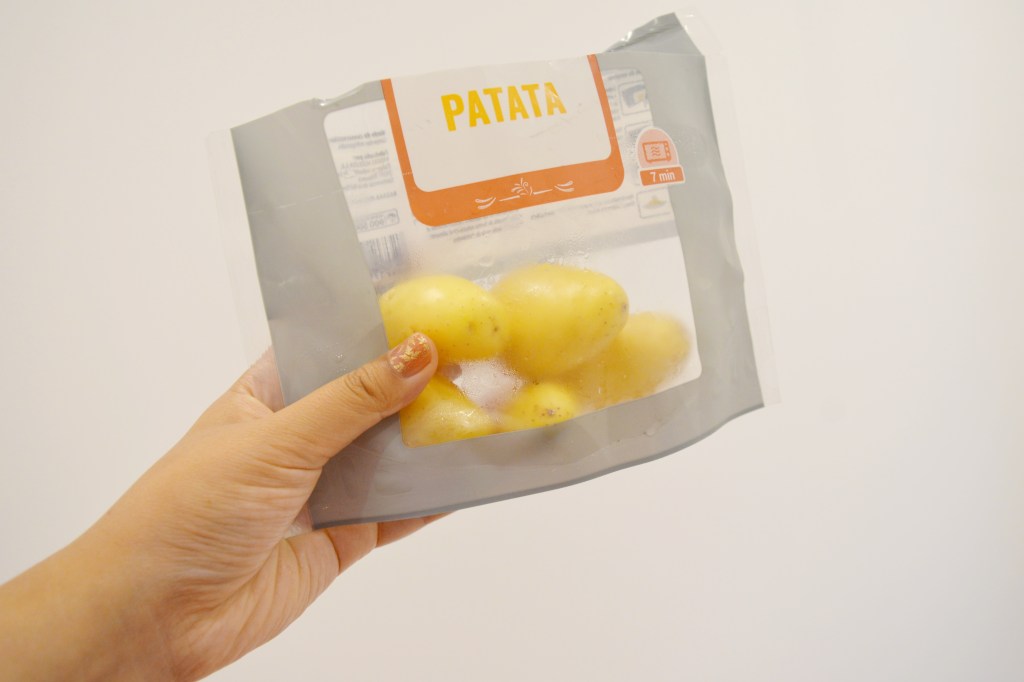
- 12 mini potatoes
- 1 head any hardy green
- 4 carrots
- oil
- 6 cups water
- salt
- pimiento dulce
- bay leaf
Directions
- Soak beans overnight, then boil for 2 hours.
- Mince garlic, toast in a pan with oil for 1 minute.
- Add seitan chunks to pan and sauté until they’re golden on the sides.
- Add drained beans and potatoes, sliced in half, into a large pot, with the 6 cups water, salt, bay leaf, and a healthy amount of pimiento dulce.
- After 5 minutes, add chopped carrots.
- After 5 minutes, add rinsed and chopped greens.
- After 5 minutes, add sliced vegan sausage.
- Once everything looks cooked through, add in seitan, and add more seasoning if necessary.
- To serve, use a slotted spoon to bring a good mixture of all the ingredients onto a plate.
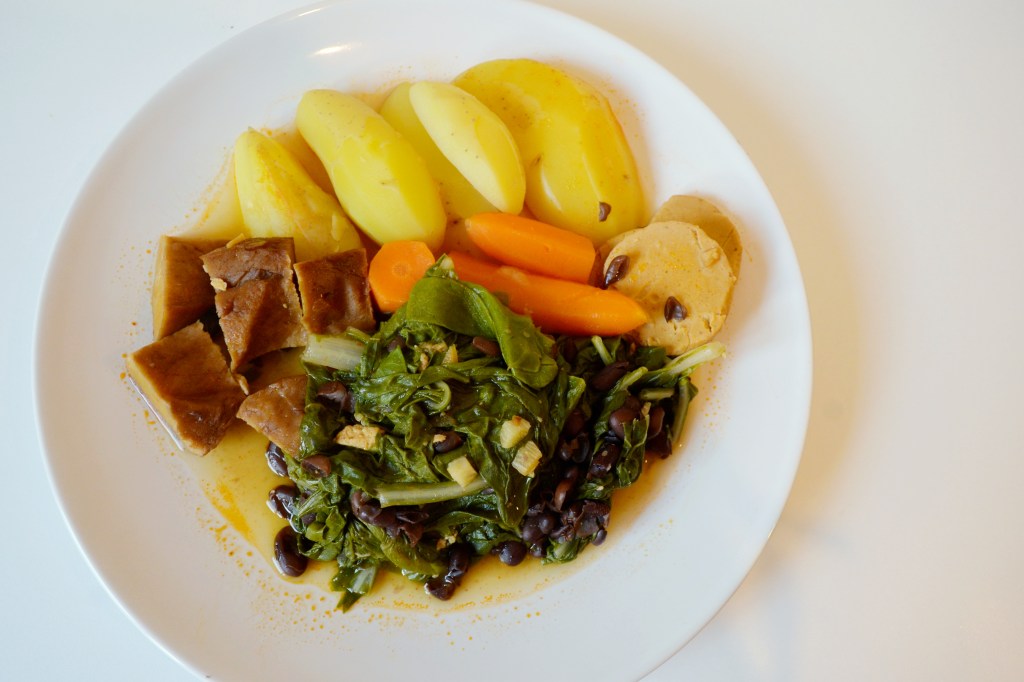
Makes 4 meals.
 Racións
You must be logged in to post a comment.