In the elevator of the apartment building I just moved out of there is a sign warning people to wear masks because COVID can linger and spread through elevator surfaces. In pencil, someone asked for references, and another pencil owner scribbled in some authors et.al.. I think this sums up the European attitude towards COVID pretty well—they generally complain and question needlessly but in the end they still do wear their masks and get their vaccines. Since I only needed to go two floors up, the ride wasn’t so eventful, just enough to glance down at this written interaction, to remember belatedly that there was no connection in the elevator, to make a funny face in the mirror and mouth some lyrics behind my sweaty mask.
A character who had a much different elevator experience is the protagonist of Kafka’s “The Tradesman.” I am reading the version published in The Complete Stories (1971). He starts out closing out his shop for the day; the nature of the shop is unspecified. He walks home and enters the lift (thanks, Willa and Edwin) and the world unfolds before him. Then he must re-enter the world and retreats to his apartment for the night.
Like other Kafka stories, there is barely start nor end here, and it’s more about the journey than the destination. And there is an undercurrent of discontent with the world. Our Tradesman is somewhere between the guaranteed wealth of the managerial class (he owns his own business and has a maid) and the conditions of the working class (“for my face and hands are dirty and sweaty, my clothes are stained and dusty, my working cap is on my head, and my shoes are scratched with the nails of crates”). In other words, like most people in the middle class, he has achieved some respectability but still has to toil to maintain his standing. Since we are given no details about the industry he’s involved in, his position is probably just a given that does not need to be elaborated on, like the existence of cars in cities; his lack of hope for upward mobility is thus fixed, at the same time that his work is never-ending. His description of his own life is a defense against people who feel sorry for him, not an exact declaration of well being.
The elevator has glass walls and a mirror, so he is able to see himself suspended apart from the rest of the world. As unearthly as it is to be caught in an ever-shifting box (happens in planes, too, in addition to elevators), he decides it may as well be anywhere else. It is unclear whom he is talking to: the stair walkers? his own reflection? the many versions of himself that could have been happier than he currently is? This addressee is reclusive at first, as the Tradesman says, “is it the shadow of the trees you want to make for?” But the addressee soars out of the building and into some busy city center, breathing a liberated air. There are children and women and sailors but all of them are simply accessories to the landscape. Sometimes he is singular and sometimes he is more than one person. He robs someone on the street but that robbery too is just a passing episode in this enlivened whirlwind of night. When the Tradesman reaches his floor, it is the utmost of tragedies: his commute, the only time in his life when he is free of obligations, has ended. The brilliant fluidity of his dreamscape will give way to doors and coat hangers and dinner plates.
I think Kafka would agree, if he lived in the current era of terribly uncomfortable budget long-haul flights, that airplane WiFi is as cursed as inventions come. The shuffling of strange children in the aisles, the continuity between blanket and seat and floor, the occasional break from artificial darkness when someone lifts a window blind, and the confusion as to whether the sandwich you’ve just received is supposed to be breakfast or dinner create just as much of a malleable cocoon as our Tradesman’s translucent elevator. Why would anyone try to break into that with updates from the unenclosed world?
Over a month ago now, a farewell was in order as two of my friends prepared to take their own long-haul flights. I made these very cakey brownies for them, courtesy of real strawberries and corn starch, although freeze-dried strawberries would have made a much smoother frosting. Their stopping by my apartment was, as the Tradesman describes of his temperamental clients, a “brief respite before their flight to America.”

Respite Brownies
Ingredients for brownies
- 1 tbsp ground flax plus water
- 4 tbsp applesauce
- 1 cup sugar
- 1/2 cup water
- 3/4 cup cocoa powder
- 1 1/2 cups AP flour
- 1 tsp baking powder
- 1/2 cup oil
- pinch sea salt
- chocolate chips
Ingredients for frosting
- 8 tbsp vegan butter
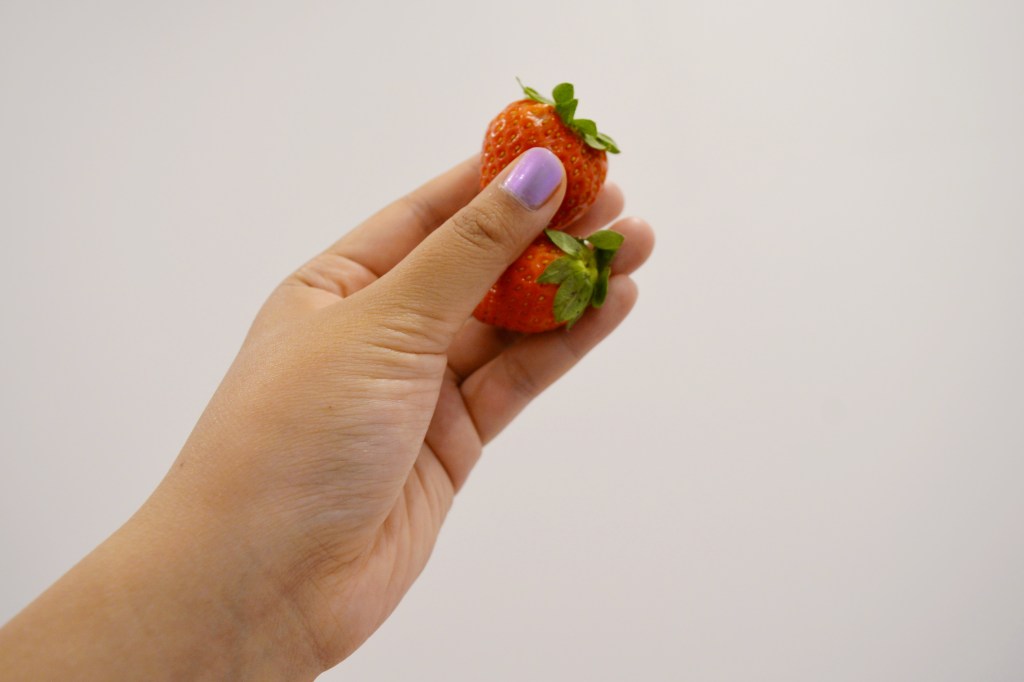
- 1 container strawberries
- 1 tbsp cornstarch
- 1 cup powdered sugar
Directions
- Preheat oven to 180 C.
- In a small bowl, combine ground flax, a splash of water, and the applesauce.
- In a small pot on low heat, dissolve sugar in water. Let cool slightly.
- In a mixing bowl, whisk together all dry ingredients (cocoa powder, AP flour, baking powder, sea salt).
- Add sugar syrup, flax mixture, and oil to dry ingredients.
- Fold in chocolate chips.
- Bake for 50 minutes.
- In the meantime, set aside some strawberries for garnish. Chop the rest finely, combine with plenty of water, and boil until completely disintegrated and a lot of the water has evaporated.
- Combine cornstarch with a tiny amount of cold water. Pour cornstarch mixture into the strawberry pot, and stir vigorously until thickened.
- Cool the mixture until room temp (30-60 minutes in freezer).
- Beat vegan butter and powdered sugar together. Add a spoonful at a time of the strawberry mixture until the frosting is almost separating (you may not have to use it all).
- Spread frosting thinly over brownies, and garnish with additional strawberry slices.
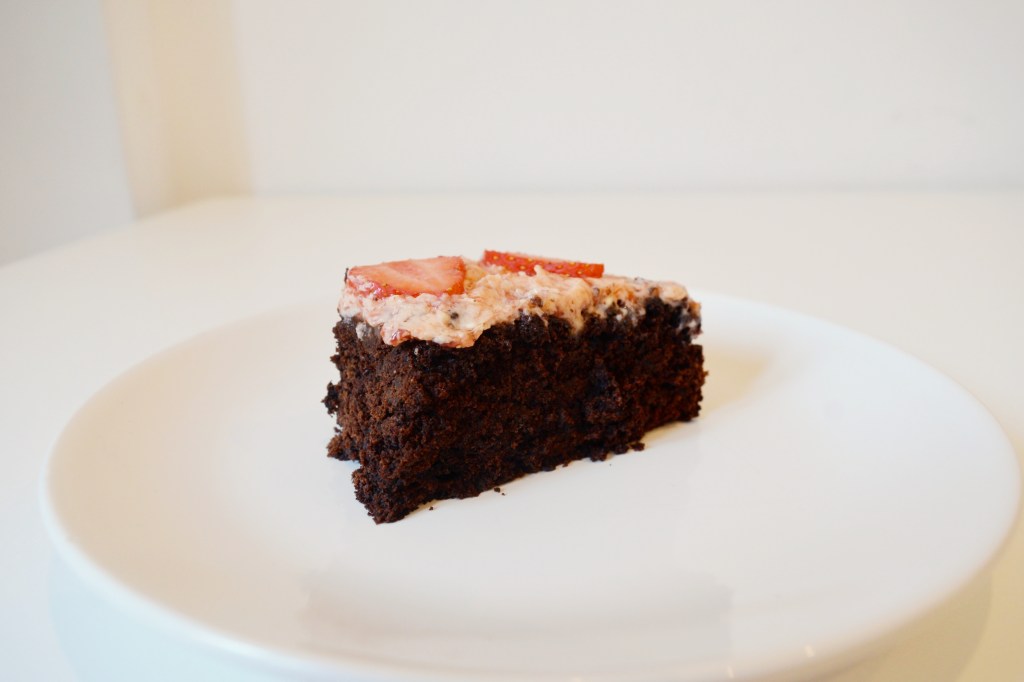
Makes 12 large brownies.
 Racións
You must be logged in to post a comment.