Institutions hold a lot of weight in modern society. From the utopian system of checks and balances between branches of the American government that we learn about in school, to the assumed prestige of anyone invited to speak at an elite university (exemplified by the shock at subsequent fallout), in the great confusing mass of information in the world facts are now distinguished from opinion by institutional esteem. This has eroded public trust in the mainstream information itself, sometimes in justifiable ways, as with the newfound popularity of critical race theory, and sometimes in unjustifiable ways, as with the conspiracy theories related to the Jan. 6 riots. Between the European Medicines Agency, national governments, and regional governments, the image of AstraZeneca has flipped so many times that there is unfortunately now a general feeling in Europe that we really can’t know anything for sure about any of these COVID vaccines. And we can condemn the anti-COVID-regulation crowd as crazy, but they are not wrong about the untrustworthiness of big healthcare companies, which, for example, caused America’s opioid crisis.
Since it is apparent that everyone will decide the facts for themselves anyways, perhaps it is better just to admit that we do so rather than relying on cherry-picked institutions as proof of the legitimacy of our thoughts. The barrage of articles that have come out since the blatantly anti-news-company rhetorical style of Trump emerged lament that we will soon no longer know what is real and what is not as belief in media institution deteriorates and as dangerous rumors fly on social media. But we know that throughout history institutions have been just as fallible to biases as individuals (such as with the scientific racism and eugenics movements), and even with the most robust evidence, our realities will always incorporate subjective feelings and experiences.
Before the modern era there were fewer of these pretensions, as there was no attempt to erase the role of the author while presenting information, like so many publications and organizations do nowadays in an attempt to be objective. This week I’m looking at the Placita Philosophorum’s Book 5, which unites the thoughts of several philosophers, helpfully without attribution removed, about the nature of life and death. As I no longer have academic library access (in this case, institutions are the gatekeepers rather than the distributors of information), I have no clue whether there is a more recent translation, but the one I am using is free online and produced by William Goodwin in 1874. I came across this source in a book about the ties between the Greeks and the Celts in antiquity, because in the last chapter our Pseudo Plutarch quotes Asclepiades as saying that British people have a lifespan of 120 years while Ethiopian people only have a lifespan of 30 years because the British climate is colder.
Our Pseudo Plutarch is sometimes a little lazy with their citations, but they never give any disembodied information, nor do they really endorse some theories over others, preferring to let the readers themselves judge. In Chapter 17, “What Part of The Body Is First Formed in The Womb,” for example, they list the responses of “the Stoics,” “Aristotle,” “Alcmaeon,” “the physicians,” “some,” and “others.” It turns out that the physicians were right, in that the heart is the first organ to form. In Chapter 20, “How Many Species of Animals There Are, and Whether All Animals Have The Endowments of Sense and Reason,” we see an interesting manifestation of speciesism in the judging of animals for their rationality, a quality used not only to define humanity but also to exclude certain humans based on race, gender, and ability throughout history. It resembles Chapter Five of Peter Singer’s Animal Liberation, except without any of the anti-speciesist commentary.
First, Aristotle believes that the stars are animals and even that God is an animal, which broadens the definition of “animal” to any natural agent and thus makes it lose meaning. “Democritus and Epicurus esteem all animals rational which have their residence in the heavens,” which kind of just avoids the question and pushes the question’s burden onto theology. Anaxagora’s answer makes no sense to me whatsoever. Pythagoras and Plato believe that an inability to speak translates to irrationality. And Diogenes says that animals are comparable to “madmen,” “the commanding rational part being defectuous and impeached.”
These answers have less to do with animals and more to do with defining humanity itself, just as in Gender Trouble we are introduced to the idea that women are a tool for defining maleness and that queer bodies are a tool for defining straightness. From this one line of Aristotle, we can imagine humans as one small piece of a vast, interconnected universe. Democritus and Epicurus reduce humans down to their fate in the afterlife. Pythagoras and Plato reduce non-verbal humans to a second class. Diogenes uses the idea of animals to reduce neurodivergent humans to a second class also. We can clearly see today that these last two are exclusionary and discriminatory, and it’s the very harmful, human-centric modern/Roman focus on rationality that attracted me to the mystical and Medieval in the first place. But by including these contrasting viewpoints and citing their sources, the author is implicitly endorsing the reader’s agency to accept or reject these theories for themselves, which unlike the heavy Church indoctrination of the Middle Ages is very refreshing.
The hilarity of taking any of these old philosophers seriously is revealed by amusing snippets from the rest of this book, which show that even by calling them philosophers rather than something like “crazy old village seers” we are proving ourselves to be a continuation of the eurocentric Enlightenment. The idea appears, for example, that men come from sperm in the right testicle and that women come from the sperm in the left one. Also our friend William Goodwin’s continual use of “matrix” for the vagina/uterus and “yard” for penis is pretty painful. Other fun claims include that children may end up looking like the figures in a woman’s imagination during pregnancy, that men become “perfect” and capable of morality when they go through puberty, and that the ancestors of humans were giants.
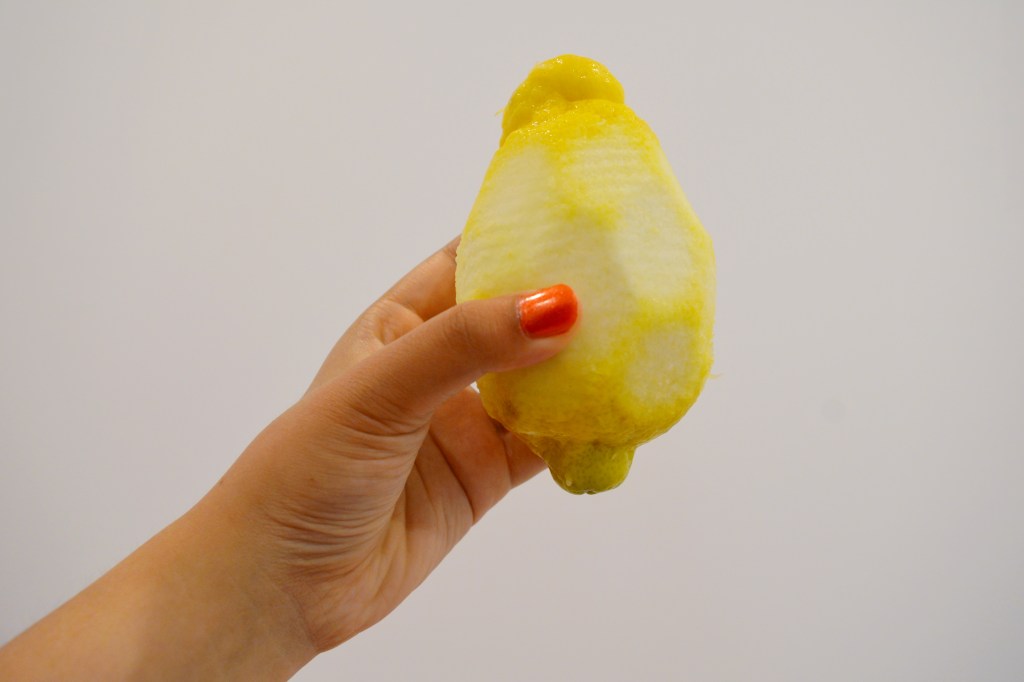
Just as I did not take these claims at their word, I did not totally trust the lemon cookie recipe that I made for my students (individually packaged, and eaten outside of class, of course, because COVID) about a month ago. As with garlic in savory recipes, I find that zest can normally be doubled or tripled without ill consequence. This dough is very soft, so if you have enough freezer space to firm these up before putting them in the oven, it would probably be a good idea. But alas I do not live in a land of big fridges and so I don’t have this luxury.

Defectuous Lemon Cookies
Ingredients
- 7 tablespoons vegan butter
- 3/4 cups sugar
- 2 1/2 cups flour
- 1 tsp baking soda
- 3 lemons
- 2 tbsp applesauce
Directions
- Zest lemons and set aside 2 tablespoons of lemon juice.
- Preheat oven to 180 C.
- Cream butter and sugar.
- Mix in remaining ingredients.
- Form dough into balls and place on parchment paper.
- Bake 15 to 20 minutes or until edges starting to brown.

Makes 28 cookies!
 Racións
You must be logged in to post a comment.