In grocery stores here it is not uncommon to see rabbits next to the types of animals more familiar to most Americans as food, such as cows, pigs, and chickens. Like chickens, and quite unlike cows and pigs, rabbits are small, so in the grocery aisles a good portion of them are not chopped into unrecognizable oblivion and made into neat blocks or rounds. Instead, they are merely skinned and beheaded and tucked between a styrofoam tray and a piece of plastic wrap, stretched out long, as if still making their last attempts to escape this terrible fate. One of the teachers at my school remarked how odd it was that people would keep rabbits as pets, since rabbits belonged in the category of food.
The sudden spike of news articles on cicadas and novelty recipes that use them grosses me out almost as much as walking through a grocery store meat aisle does, although the cicadas are at least luckier than Spanish rabbits in that their long reproductive cycle makes them nearly impossible, or at least exorbitantly difficult, to domesticate and breed. It is fairly obvious to vegans that breeding is ethically wrong for several reasons: animals are picked and chosen for traits desirable to humans but perhaps harmful to their own well-being, animals are treated as commodities to be bought and used and sold (whether as a product, as with meat/fur/leather/pets, or as capital, as with milk/eggs/honey), in the case of many farm animals breeding is dependent on bodily violation, in the case of pets it is often possible to prevent a shelter pet’s euthanization instead of enriching breeders, and most importantly, animals’ agency over their own bodies and lives is violated.
So now we must look ahead to a world in which the majority of people do not consume animal products and the animal agriculture industry is at last put to rest. If this change happened suddenly there would be over 22 billion living domesticated animals who are freed yet placeless. It is possible that domestic rabbit (and cow, and pig, and chicken, etc.) populations could simply be reduced drastically across a few generations through less breeding, as was the case with horses in the twentieth century, whose population in the U.S. dropped from 26 million in 1915 to 3 million in 1960 due to the ending of the world wars and the rise of cars and powerful agricultural technologies. Reducing farm animal populations to this degree, especially that of cows, would already be monumentally beneficial for the environment. The horse industry, however, is not a stellar ethical model, as horses are mostly bred today for humans’ leisure and thus are still treated as commodities.
Let us also assume a non-capitalist world in which non-profit-driven relationships are not only possible but prioritized. In this mindset, I read chapter 17 of Sunaura Taylor’s Beasts of Burden: Animal and Disability Liberation (2017), which asks us to consider an alternative, non-exploitative relationship to domesticated animals, whom we have bred to serve our own interests. Taylor draws parallels between social attitudes towards disabled people and towards domesticated animals: both are considered inferior to their (able-bodied and wild, respectively) counterparts and less worthy because of their dependency on others. Steve Irwin, for example, is famous for defending the rights of Australian wildlife yet still ate meat, implying that domesticated animals are somehow second-class. And punishment for disabled people’s dependency is written into law: in the U.S., social security benefits and health insurance can be taken away if a disabled person and their spouse have more than 3,000 dollars in the bank. From this perspective, an animal that is domesticated and disabled is truly at the bottom of the heap.
Since animal exploitation and ableist discrimination both rely on a hierarchy of life that assigns value to beings based on arbitrary traits such as fitness and intelligence, it is logically impossible for anti-ableism work to occur without also considering animal liberation; in other words, animal and human liberation rely on one another. Taylor prefers a “feminist ethic of care [that] avoids privileging such traits as rationality, autonomy, and independence—attributes that have historically been used to oppress and mark boundaries between deserving and undeserving beings” (207).
It seems twisted that we will be in charge of rehabilitating a population we created for our own enjoyment. In our current climate, farm animal sanctuaries are so few and so underfunded that an impending end to the profitability of animal agriculture would probably prompt most animal farmers to send all their animals to the slaughterhouse for one final terrible series of killings. But anyways, what are our ethically acceptable options? Maybe farmers would live up to the advertisement that they treat their animals like family and be willing to care for the animals for at least the rest of their natural lives without any promise of monetary benefit. Taylor discusses this extinction model, in which humans would just stop breeding domesticated animals entirely and let them die off within a generation or two. While seemingly innocuous, however, this kind of human-driven extinction comes uncomfortably close to the idea of eugenics: “In human eugenics, perfection meant getting rid of ‘unwanted’ characteristics such as disabilities, while animal breeders have often pursued perfection by enhancing certain characteristics to the point where they easily could be classified as disabilities or deformities” (216).
Taylor’s proposal for caring for the world’s domesticated animals is the same as the one she, as a disabled person and disability activist, espouses for herself. She believes that we should listen to and be attentive to the needs of these animals so that, rather than animals’ being either a resource for or a burden upon humans, our relationship can be one of interdependence, freed from cycles of exploitation. For all the abuse that humans have waged against animals since the beginning of animal agriculture, we owe them back their agency, at least. Instead of discarding animals or letting them die off, “we could recognize our mutual dependence, our mutual vulnerability, and our mutual drive for life” (218). We are constantly seeing the idea come into the mainstream that the purpose of life is living itself (see Soul or Dear Evan Hansen finale). Aren’t our capacities for life equally rich and full, regardless of species or ability?
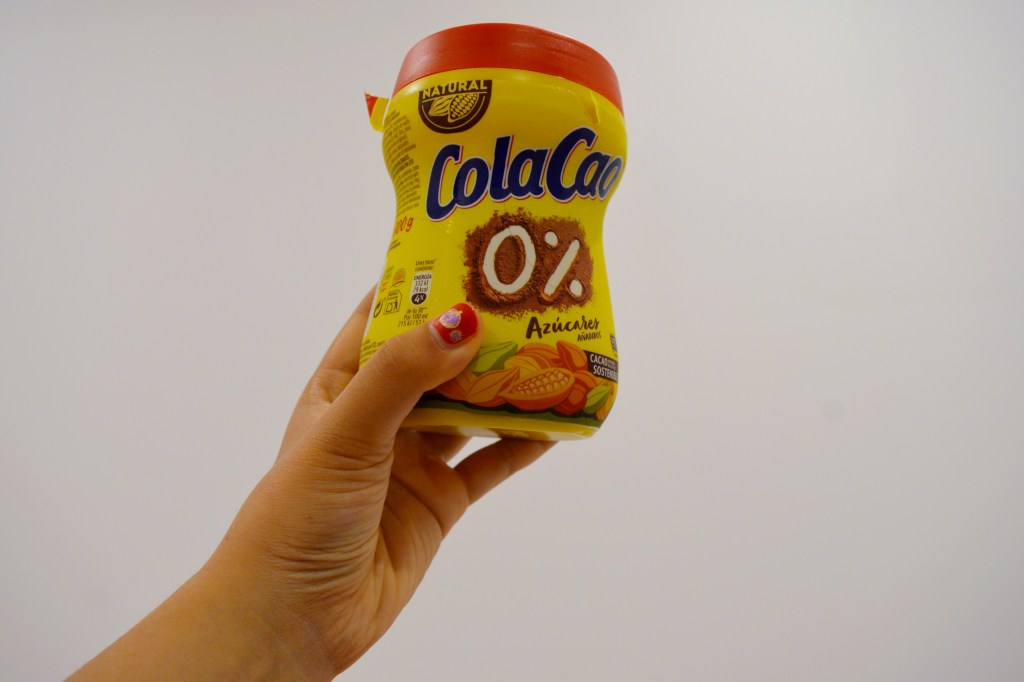
I am still catching up with these posts (I have discovered that the May slump occurs whether or not I am enrolled in school), but this week’s creation is a celebration of life, specifically of one of my friends’ completing another year of it. If you don’t have Colacao you could use any chocolate milk powder or hot cocoa mix.
Drive-for-life Mini Birthday Cake
Ingredients for cake:
- 2 1/2 cups AP Flour
- 1 cup sugar
- 1 tablespoon baking powder
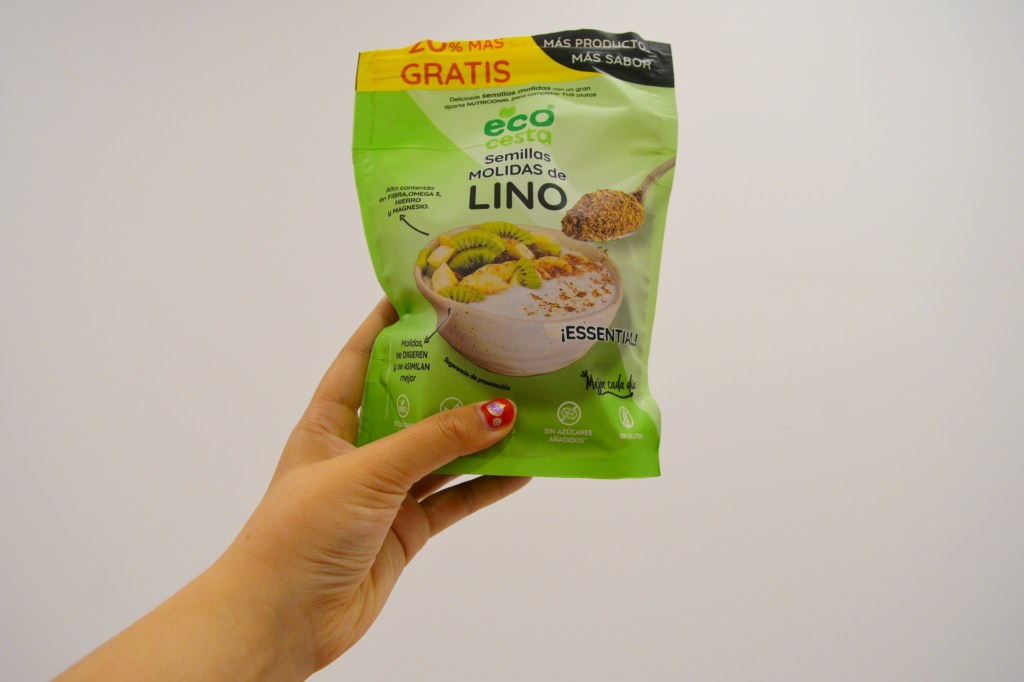
- 1 tablespoon ground flaxseed
- 1 1/2 cups oat milk
- 1/2 cup oil
- salt
- cinnamon
- powdered ginger
Ingredients for frosting and decoration:
- 1/2 cup Colacao
- 350g unsalted vegan butter (a little less if you don’t plan on making cake pops)
- chocolate hazelnut spread
- sprinkles
Directions
- Preheat oven to 180 C.
- Mix all dry ingredients together (flour, sugar, baking powder, ground flaxseed, and salt, cinnamon, and powdered ginger depending on personal preference).
- Add wet ingredients (milk, oil), and mix until just incorporated.
- Pour half into a lined baking tin.
- Bake for 20-25 minutes. Remove cake from tin, re-line, and fill with the rest of the batter. Bake for 20-25 minutes again.
- In the meantime, mix your vegan butter and Colacao until light and fluffy.
- When cakes are cooled, use a cup or cookie cutter to punch out circles.
- For each mini cake, adhere one circle to some parchment paper or a cake base with a tiny bit of frosting. Pipe a ring of frosting on top, and fill the middle with chocolate hazelnut spread. Add a second circle on top. Pipe frosting all across the top, and add sprinkles. Leftover cake scraps and frosting can be used to make cake pops!
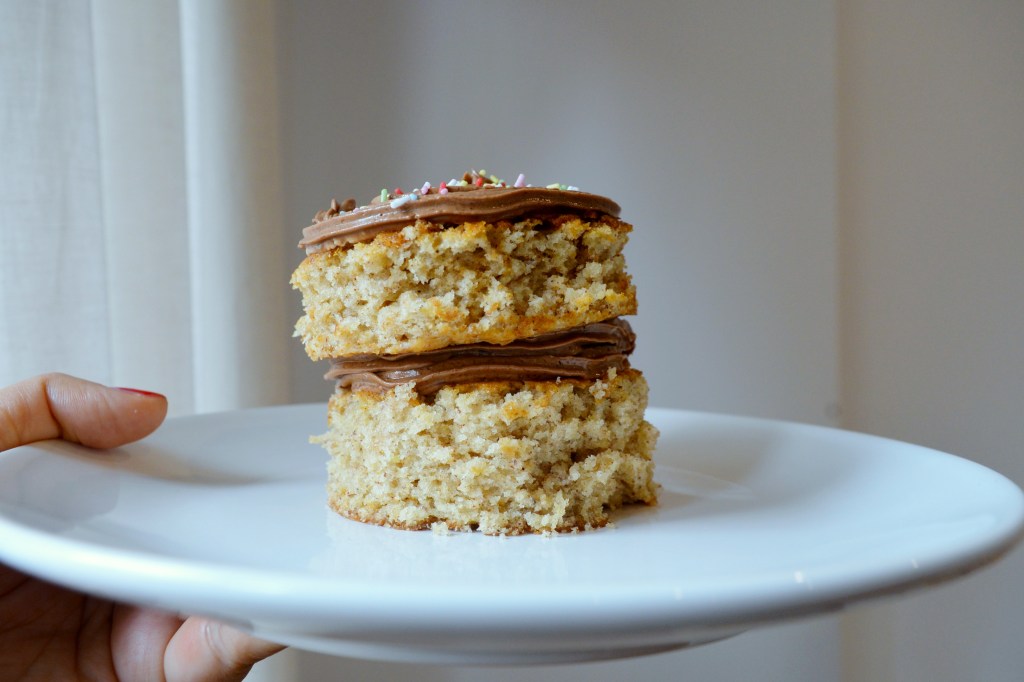
Makes 5 mini cakes.
 Racións
You must be logged in to post a comment.