Landscapes in the north of Spain are enchanting not because of their grandness (although they do possess this as well, and to such a degree as Rabbi Heschel says “everyone will admit that the Grand Canyon is more awe-inspiring than a trench”) but because they are always shifting. The sky that shifts between blasting heat and pouring, the sea that shifts between pond-like serenity and violent sprays, the trees that shift between bare and verdant because they know the seasons even as the temperature here largely never changes. I admit that before landscapes, whether novel or familiar, nowadays I have two emotions: touristic awe or disinterested oblivion. I had forgotten that once when my mental health was in the dredges all natural features in their tranquility seemed personally offensive, but this week I read Rosalía de Castro’s Orillas del Sar, in which her narrator curses out everything around them that dares to be more at peace than their own internal storm of anguish. I am using the version in On The Edge of the River Sar: A Feminist Translation, translated by Michelle Geoffrion-Vinci and published in 2014 (the original came out in 1884).
The offense that nature has committed against Rosalía’s narrator is that of aging, and the piece of nature that offended was right where she lived at the end of her life, as she describes the local features of Padrón and Iria Flavia. The narrator idealizes her youth as something beautiful and delicate and wrested from them. It felt a little alarming because I am quickly approaching her position. A few weeks ago Sour came out and I realized the distance between myself and seventeen. Although I am still young by global standards (I am still under 29.6, which is the median age of humans on earth, and even better I’m far from 43.2, which is the median age of humans in Spain), I am now in that vast stretch between continuous schooling and festchrift/death in which age loses meaning and my body becomes a sanding block for capitalism. As Rosalía published this poem in her forties, a year before she died, I’m sure she felt this bothersome emptiness more than I do. Since this is the nineteenth century and we’re talking about the idea of being ruined when your youthful beauty disappears and about such things as “virginal fragancia,” along with Rosalía’s uterine cancer and the possibility that this poem is autobiographical, I think it’s pretty safe to say that the narrator is a woman although it’s never explicitly stated.
Whatever regretful event happened during the narrator’s youth or caused an unwanted transition out of youth is never explicitly explained, but we get hints and pieces through reminders that the narrator finds in natural landscapes. The calm of nighttime, for example, is filled with “sombrío” and “halagüeño,” of “negras traiciones” and “dichas inmensas.” She reminisces about “aquellos días hermosos y brillantes/en que las ansias mías eran quejas amantas,/eran dorados sueños y santas alegrías.” The idea of the fountain of youth of course makes an appearance, as the narrator recalls that she once drank “néctar sano” but now only has “las aguas del olvido.” And since we’re in Spain, the poem would not be complete without a reference to the nursing Madonna; the narrator believes that the opportunity to be the chosen one and the opportunity for nourishment have passed her by: “Mas el calor, la vida juvenil y la savia/que extraje de tu seno,/como el sendiento niño el dulce jugo extrae/del pecho blanco y lleno/de mi existencia oscura en el torrente amargo pasaron.”
The narrator has a hard time positioning herself. In fact there seems to be a struggle between covetousness for nature’s youthful energy and portraying herself as an outsider, and her admiration for it, portraying herself within nature. In the first stanza, she laments, “desde mis ventanas veo/el templo que quise tanto.” Later, however, she claims that the “viento de tempestad airada” snatches away her desire for justice, which sounds pretty difficult to achieve through a window. Curiously, here Rosalía uses the first-person plural and implies that this group is a foil to the “siempre fecunda y bella” land, so perhaps she is attempting to represent all people who feel slighted by the passage of time, or who feel drowned out by the insignificance of a human life in the timeline of the universe. She then says that natural symbols of beauty, like mountain valleys and peaks, like the sunshine and fragrances of summer, come in vain, because within themselves are already harbored negative things like hatred and shame. But once again, it seems difficult to come to this perspective that perhaps the livelier parts of nature could act as medicine (a physiological cure) to make us livelier again if the narrator were isolated from nature. The poem’s ending clarifies that the narrator does experience nature but only at night; she intentionally avoids the daylight, thus ironically making them more into the kind of wasted away, ghostly figure that they despise being.
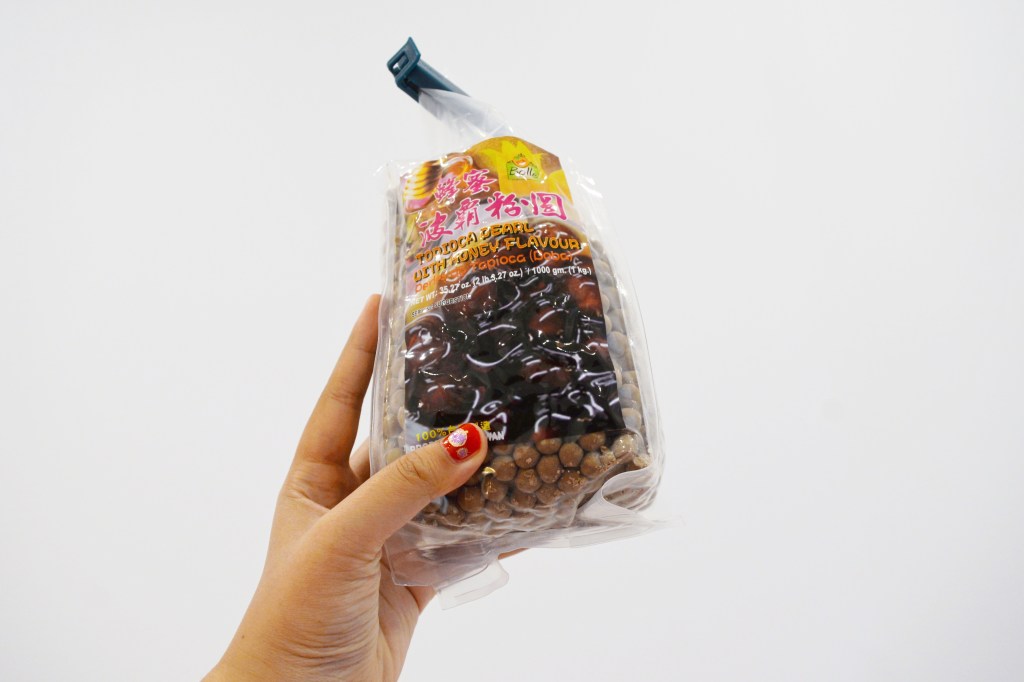
From time to time I do feel a little annoyed by the buoyant rhythm of nature (why do I already have back pain?). But for the most part I find Rosalía’s interpretation of her surroundings very pessimistic and centered on feelings that I just cannot relate to, like the desire for biological fertility. This week I made a drink that requires a little agitation but as a whole is rosy and pleasant. Boba is pretty hard to come by around here so I was so thrilled to discover that I could make it so easily at home.
Living-Splendor Boba
Ingredients
- 3/4 cups dry tapioca pearls
- 3 tablespoons brown sugar
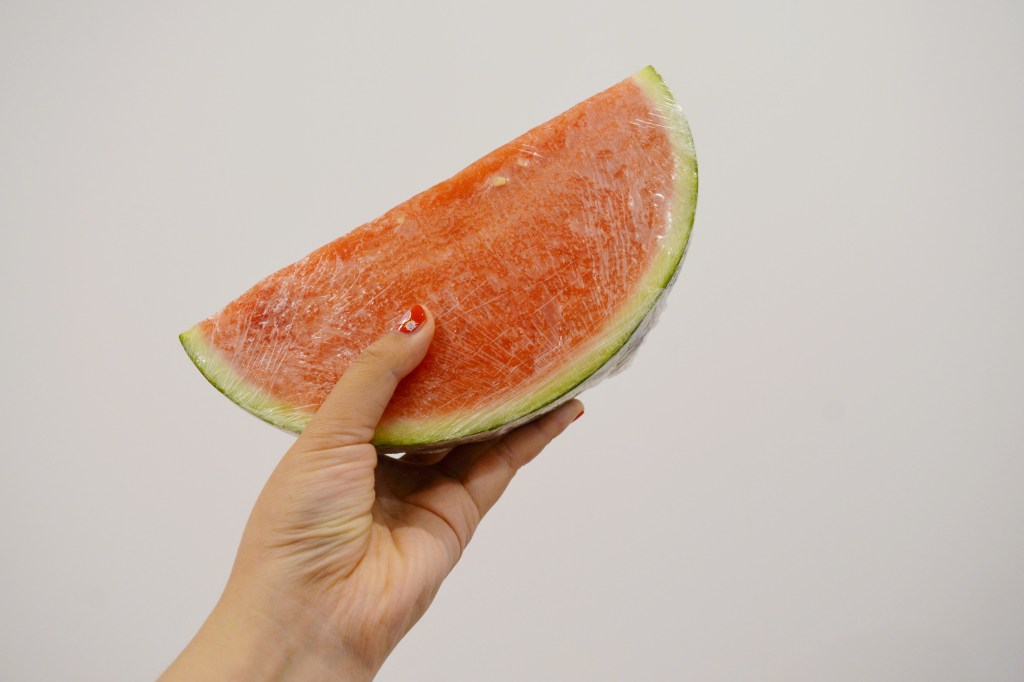
- small section watermelon
- fresh orange juice
- water
Directions
- Bring a pot of water to a boil.
- Add tapioca pearls, and stir continuously. These already flavor-coated pearls take about one round of 10 minutes (10 minutes boiling, 5 minutes sitting); normal unflavored ones take two rounds of 20 minutes (20 minutes boiling, 10 minutes sitting).
- Prepare a mixing bowl and fill it with ice water. With a slotted spoon, scoop out the boba into the ice water. If a second round is needed, dump out the murky boba water, add new water, bring to a boil again, and repeat.
- Drain boba from ice water, put it back into your empty pot, add a quarter cup water and the brown sugar, put on low heat, stirring continuously, for a few minutes or until the water and brown sugar start to thicken into a syrup.
- Remove from heat and allow to cool for 5 to 10 minutes.
- In the meantime, cut your watermelon into small sections and mash with a fork. Most of the watermelon should turn to juice. (This step would probably be easier with a blender.)
- Spoon about an inch of boba into your glass. Strain and add watermelon juice. Fill the remainder of the glass with orange juice.
- Enjoy immediately! Boba doesn’t keep in the fridge so you must make it fresh every time.
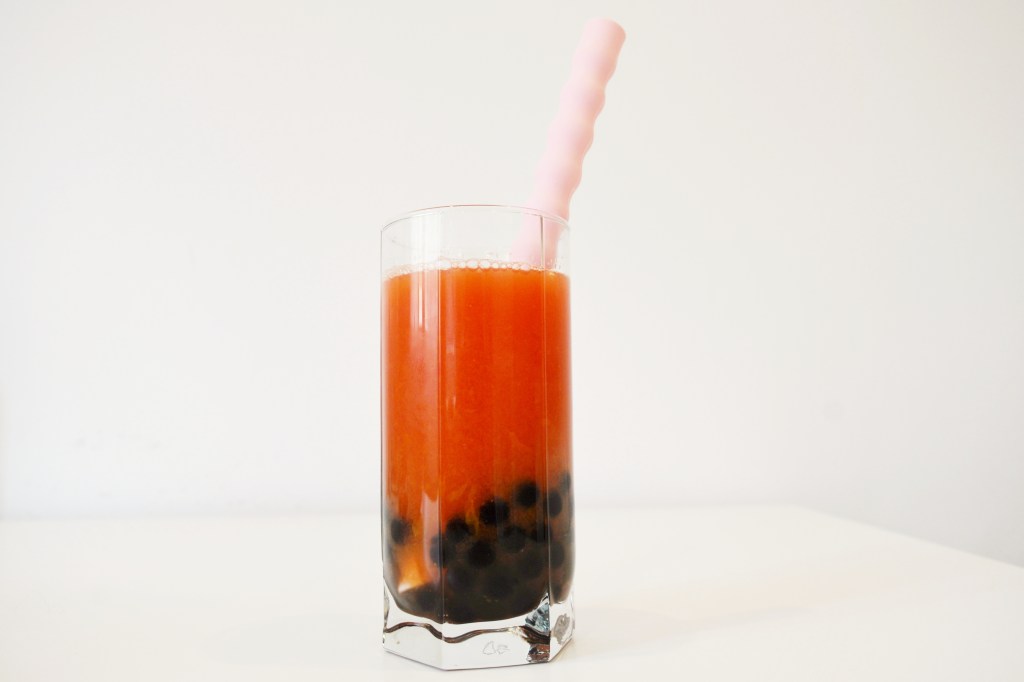
Makes 2 glasses.
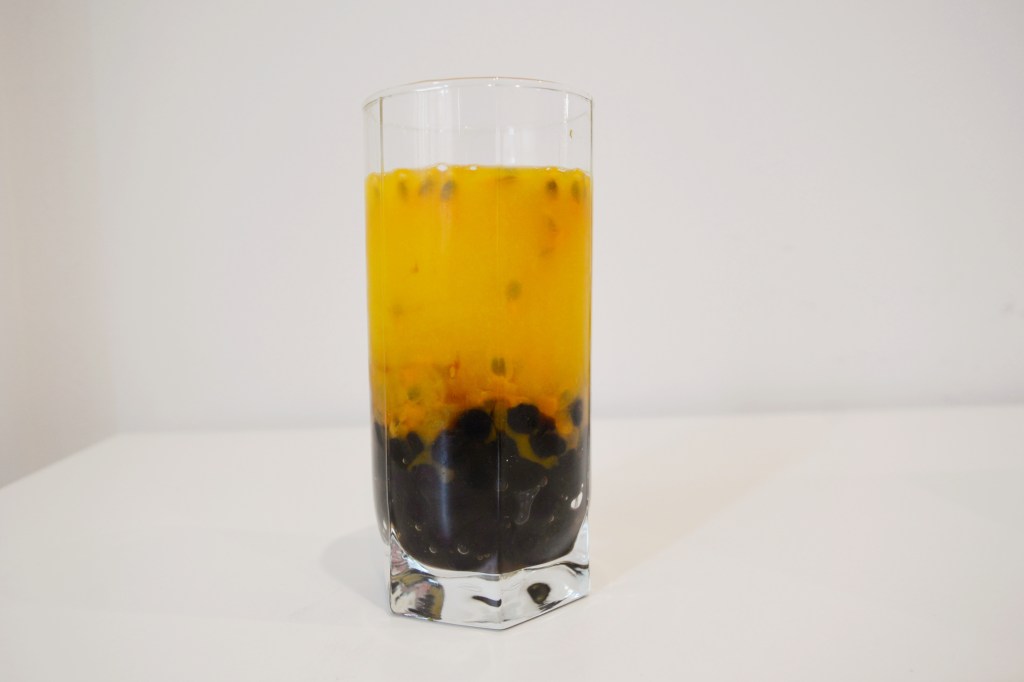
Alternatively, try with fresh passionfruit instead of watermelon juice for a tangier finish!
 Racións
You must be logged in to post a comment.