This week I read a poem titled “El Beso” by Esther de Cáceres, from her 1963 book Los Cantos Del Destierro. Although she was Uruguayan, at the end of her life she fell sick and chose to spend her final days in Galicia, so the Galician cultural office has on their website a collection of letters that she sent to friends throughout her life. The page lists her location of death as Rianxo, a mere 40 kilometers from Santiago de Compostela and on the same coast that boasts the end of the world, Fisterra. Her last letter, less than a month before her death, is from the city of Coruña, where she gushes about a book and its implications about pilgrimage.
I’m typing out her poem here:
Heridos pies que saben
la celda estrecha y el camino largo
desde el paisaje tierno
de Asís hasta la dura
llanura castellana se buscaron.
El alma de Francisco en Compostela
todavía labra
la piedra viva y santa;
y Domingo despierta, en primavera,
la luz de los azahares asomados
a la dulce colina, en luz romana.
Ya cantan su concierto las distancias.
Heridos pies sagrados
se acercan y se juntan; porque se han encontrado
las invisibles alas de los Ángeles
que este paso acompañan.
Y los dos Santos
—peso y vuelo rimados—como un arco
se estrechan en abrazo que el Espíritu Santo
rige desde lo Alto.
Se tocan las mejillas
labradas por el llanto
y el beso de los salmos
canta la alianza.
Ya los pobres del mundo a la luz de este beso
encontrarán descanso, claro saber de Gracia
dorado pan y libertado canto,
junto a la ardiente hoguera levantada
—arco de amor—por Santos Mendicantes.
“La justicia y la paz se besarán.”
Salmo 84
This poem seems to tell the story of thirteenth-century saint Francis of Assisi’s pilgrimage to Santiago de Compostela. She describes the pilgrimage as a living history. The soul of Francis, who was a prolific preacher, “is still at work/in the living and holy stone.” The sunlight that falls upon the hills of the camino is “Roman.” Angels are never far from the route. The “two saints” (perhaps Francis and James?) have touched pilgrims’ tear-riddled cheeks. And just as it was for actual pilgrims during Francis’s time, she emphasizes the importance of physical suffering for spiritual growth, as the only phrase that she repeats throughout the whole poem is “heridos pies” (wounded feet).
The same rejection of material comfort can be found in the writings of Clare (Chiara), one of Francis’s friends and also a leader in reforming monastic life. I am using a 1665 English translation entitled The First Rule of the Glorious Virgin S. Claire because her Regola is not available online and besides it would take quite a while to get my Italian back from the grave, never mind its still latinate medieval form.
I was particularly impressed with the section entitled “That the sisters shall not appropriate any thing to themselves, and of the sick sisters.” The second article states: “Lett them send for almes with confidence: neither ought they to be ashamed therof; seeing our Lord made himself poore, in this world, for love of us.” Although this dedication to poverty and surviving purely on alms was what defined the order, it is still astonishing to see this pride in poverty and this idea that being poor makes us better reflections of Jesus himself, during the modern era where capitalism mandates that poverty be associated with immorality. Poverty in this context, just like the wounded feet in de Cáceres’s poem, is a payment for a higher reward. Clare uses words that directly invoke the possession of great wealth, saying that the sisters would be “heires, and queen’s of the Kingdome of heaven.”
Her attitude on money becomes more clear in the fifth article, which states: “if anything be sent to any sister from her Parents, or from any other person, the Abbess may grant it her, and [if need] she may make use of it; if not, the Abbess in charitie, may dispose of it, to relieve the wantes of an other that needs.” Since convents served as financial institutions, either to preserve the wealth of noble families through their maternal lines, or to house the daughters or widows of poor families who could no longer afford to keep them, this policy of redistribution shows that Clare places no object on money whatsoever and that money itself and the inequality it creates, not the suffering from lack of material pleasures, is the target of her poverty vow. And finally, the seventh article is evidence of the optimism of her vision: “Lett them declare freely, one to the other, their necessitie: for if a true mother doth love and nourish the child of her wombe, with how much greater diligence and care, ought a sister to love and cherish her spiritual sister.” Here Mary is namelessly invoked in setting the standard for motherly love, but it is interesting that Clare believes a sororal love should supercede this. In much the same vein as her belief that money should be given freely based on need and not on status, a sororal relationship is that of equals, which is more meaningful than that of a dominant parent and a dependent baby, or any hierarchical relationship like that of the master and servant. It is no wonder that de Cáceres invoked these ideas in her poem; the camino, after all, bashes in every pair of pilgrimaging feet more or less the same and makes us all into spiritual sisters, if only briefly.
Just like the “pillowes of feathers” that Clare permits in the case that a sister is sick, the conchas that I made this week are light and fluffy. I had neither the mixer nor the concha cutter that the original recipe asked for (nor the two mixing bowls to be honest, so I had to briefly use a saucepan), but after two rises I don’t think it made much of a difference.

Pillowey Conchas
Ingredients (bread)
- 1/2 sweet potato
- 10.1g yeast
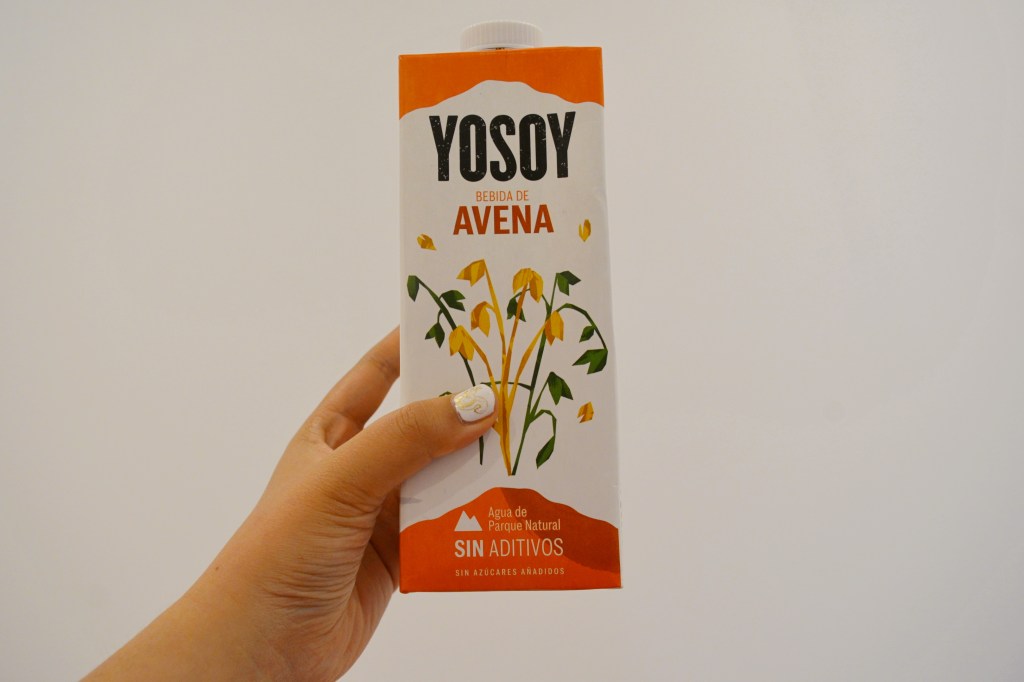
- 1/2 cup oat milk
- 2 1/4 cups bread flour
- 1/2 cup sugar
- 7 tablespoons butter, melted
Ingredients (topping)
- 1/3 cup sugar
- 5 tablespoons butter, room temp
- 1 cup AP flour
pinch vanilla powder - pinch cinnamon
- few drops red food coloring
Directions
- Mix together bread flour and sugar.
- Peel and cube your sweet potato. Boil until very soft. Mash with a spoon and set aside to cool.
- Microwave the milk until warm but not hot. Mix in yeast and check to see that it’s bubbling.
- Mix sweet potato, milk/yeast, and melted butter together.
- Incorporate all bread ingredients with a spoon. Let rest for 15 minutes.
- Knead gently for 15 minutes or until no longer breaking with stretch-and-folds.
- Place into a parchment-lined bowl and cover with plastic wrap to rise for an hour or until doubled in size.
- In the meantime, mix all topping ingredients together and form into ball. Refrigerate until ready to use.
- Cut bread into 12 equal pieces and roll into spheres. Place on a lined baking tray and let rise for 40 minutes.
- Cut topping dough into 12 equal pieces and roll into spheres. Shape each one into a flat disk and place gently onto bread rolls.
- With a knife, slash the topping gently to create “shell” lines.
- Let rise for 20 minutes more.
- In an oven preheated to 180 C, bake for 20 minutes.
- Let cool before serving. Store in an airtight container.
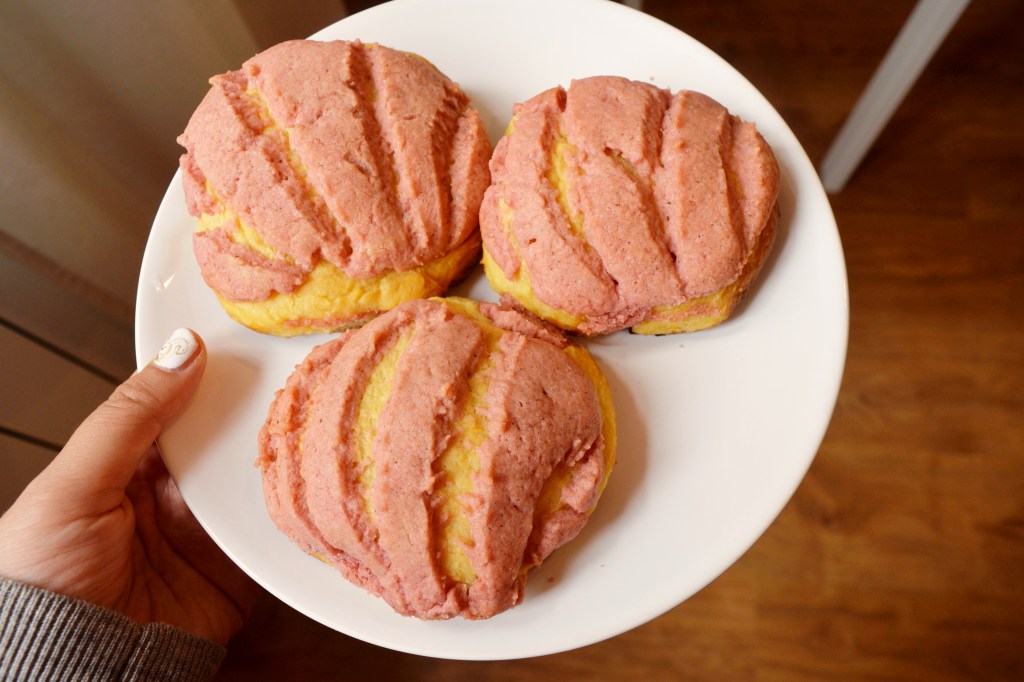
Makes 12 conchas.
 Racións
You must be logged in to post a comment.