In front of the Santiago de Compostela cathedral’s basilica entrance, which is currently acting as the main entrance since the actual main entrance seems to be under perpetual construction (seriously, they said that they wanted to be done by this year for Xacobeo, but the same scaffolding that I saw there three whole years ago is still up!), there is a beautiful fountain. On its lower level, water shoots from four horses’ mouths, and above the horses and an unidentifiable slithery scaly thing, a woman sits, enthroned, with a star dripping into her right hand and parchment with cross and shell in her left. I love it mainly because the water and the woman’s pose bring a certain life to that the somber and James-focused cathedral lacks; also it’s an easily identifiable landmark, and I get lost a lot.
Apparently Federico García Lorca is referring to this fountain in his poem “Danza da lúa en Santiago,” which I will reproduce here. It was a part of Seis Poemas Galegos (1935).
¡Fita aquel branco galán,
fita seu transido corpo!
É a lúa que baila
na Quintana dos mortos.
Fita seu corpo transido,
negro de somas e lobos.
Nai: A lúa está bailando
na Quintana dos mortos.
¿Quén fire poldro de pedra
na mesma porta do sono?
¡É a lúa! ¡É a lúa
na Quintana dos mortos!
¿Quén fita meus grises vidros
cheos de nubens seus ollos?
¡É a lúa, é a lúa
na Quintana dos mortos.
Déixame morrer no leito
soñando na frol d’ouro.
Nai: A lúa está bailando
na Quintana dos mortos.
¡Ai filla, c’o ar do ceo
vólvome branca de pronto!
Non é o ar, é a triste lúa
na Quintana dos mortos.
¿Quén xime co-este xemido
d’inmenso boi malencónico?
Nai: É a lúa, é a lúa
na Quintana dos mortos.
¡Sí, a lúa, a lúa
coroada de toxo,
que baila, e baila, e baila
na Quintana dos mortos!
The line in question is near the beginning: “Quén fire poldro de pedra/na mesma porta do sono?” I am still an absolute beginner in this language, so I am not quite sure what “fire” is supposed to be. The 1986 Gallego/Castellano bilingual version by María Victoria Atencia translates it as “hiere,” but that is the indicative present of “herir,” while according to the RAG, “fire” can only be the imperative form of the the gallego equivalent, “ferir.” But Lorca does use many terms that the RAG notes for some reason as un-preferable (laio for laído, ar for aire), and there are strangely spelled words like “frol” (flor) and “agoa” (auga) and “brila” (brilla) that I really had to work hard to identify. So “fire” could very well be a rarer version of ferir’s indicative present.
The 1986 castellano version puts it thus: “¿Quién hiere potro de piedra/en los umbrales del sueño?” In In Search of Duende (1998), Norman di Giovanni ed. Christopher Maurer translates this line as “Who wounds the stone foal/at the very portal of sleep?” A Gallego/English edition (2004), also edited by Maurer and translated by others (I do not have the whole volume so I cannot identify who in particular translated this poem), goes “Who wounds the stone colt/at the portals of sleep?” And Andrew Anderson’s appendix in Lorca’s Late Poetry: A Critical Study represents this line as “Who is wounding a stone pony/on the very threshold of dream?”
Since the RAG defines “poldro” as a male or female horse from birth until its adult teeth come in, around four years, I decided to go with just “horse,” since none of the similar words in English are really an exact equivalent (“colt” is male only, “foal” is only up to a year of age, “pony” is restricted to smaller breeds of horses), and “young horse” would be unnecessarily wordy. I decided to keep the “of stone” rather than moving “stone” to precede the noun because “stone horse” is immediately inanimate, while “horse of stone” is at first a creature and then given an inanimate image. I am using “troubled,” which is not a literal translation, because it is the closest antithesis to the idea of “sono,” while “wounding” or “hurting” is much more intentionally malicious and difficult to pair up with the image of the moon. The RAG defines “portal” literally as “door,” so I am not quite sure why all of the translators I listed got very creative with this and made it into “portal,” which is way too sci-fi, or “threshold”/“umbral,” which I enjoy immensely but which is too unfaithful for my taste. I modified “door” slightly into “doorway,” just to imply some movement, since it is really a doorway into sleep, I think, although I did not want to change the preposition itself, for fear of overly inserting myself. And for the final word, I think Anderson might have used “dream” because in castellano sueño means both sleep and dream, but in gallego there is a distinction between sono and soño. Both versions related to Maurer uses “sleep,” which is perfectly fine, but I thought that “sleep” was a funny concept to bring up when the poem is set at night and the narrator (and all the characters in this plaza) are so clearly not sleeping, so I chose “rest” as a more general word, and also something that must be calm and free of this bewitching presence of the Santiago moon (sleep, on the other hand, does not have to be restful!). All in all I would translate this line as “Who troubles the horses of stone/in this very doorway of rest?”
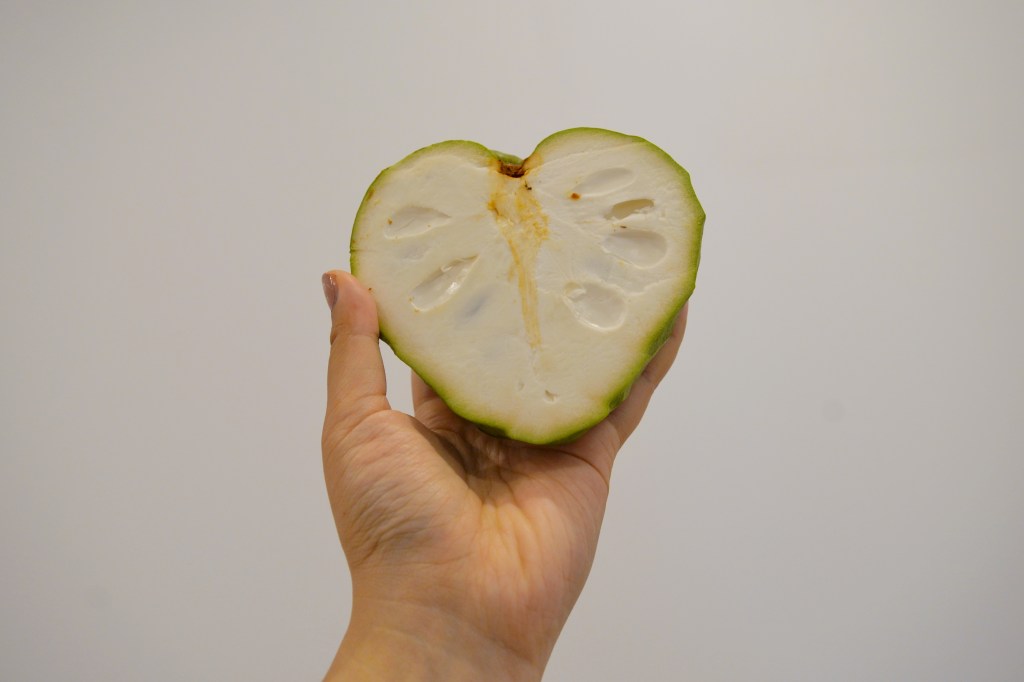
Like the young man in the first line of the poem, like the mother’s face at the end of the poem, and like the camellias in Lorca’s other poem about Santiago (“Madrigal â cibdá de Santiago”), most of the fruits, minus the blush of the jumbo strawberries, that I used in my fruit salad this week are rather colorless. The other stuff I added to the plate to make it somewhat resemble the tostada breakfasts I’ve been having all week at tiny rural cafes, little toasted baguette slices topped with vegan butter, fig jam, and peanut butter, are similarly more shades of white and beige and neutral. If I had a blender I might put these ingredients with a banana and some orange juice and make it a smoothie.
Pallid Fruit Salad
Ingredients
- 1/2 cherimoya
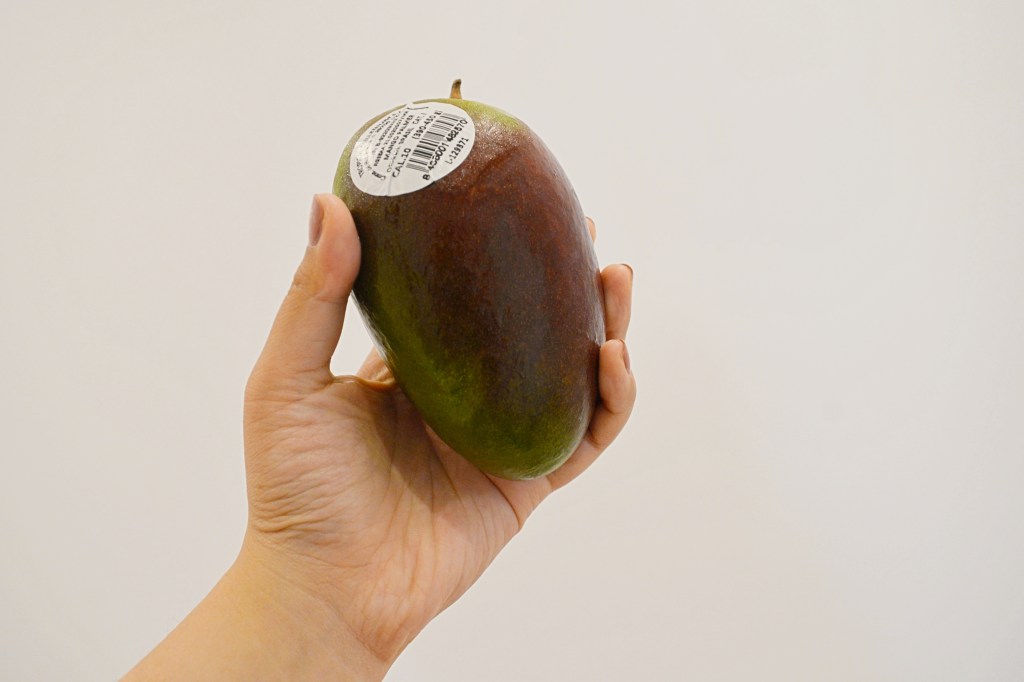
- 1 mango
- 1 container strawberries
- 2 oranges
- juice of 1 lime
Directions
- Slice off cherimoya peel and pick out seeds with a fork. Slice off peels of mango and orange as well.
- Cut cherimoya, mango, strawberries, and oranges into reasonably sized pieces. Squeeze lime juice on top.
- Pair with toast for a breakfast or snack!

 Racións
You must be logged in to post a comment.