Before my campus closed down, I truly underestimated the glory of my campus library, the convenience of going to shelves and finding twenty books, and of sitting with those twenty books all together at my desk with two different types of tea until I was physically sick of Foucault. In my current area, COVID restrictions had kept libraries, museums, and universities closed until just a few weeks ago. And I am still apprehensive about going at all, because the safety of sitting indoors for multiple hours with other people, even masked, seems questionable. For the last month or so there have been two student teachers from the Universidade da Coruña at my school, and when I asked them about their university library, unfortunately neither of them seemed very familiar (although I’m not quite sure how, since they are finishing up their Masters). So library spaces for me are, for the foreseeable future, just a figment of my memory.
Keeping with the theme of children mourning their parents and of teachers mourning the futility of their teaching, this week I read the short story “A Biblioteca,” by Lima Barreto. Just like all of the living characters in the story in relation to the old volumes in their home library, I am completely unfamiliar with Lima Barreto’s work, and I chose to read this story solely because of its title, out of a general nostalgia for libraries. I’m using Lili Schwarcz’s annotated version of Barreto’s stories, and “A Biblioteca” is grouped under Histórias e Sonhos, first published in 1920, shortly before Barreto’s death in 1922. Since I’m reading an .epub, there aren’t consistent page numbers. In a footnote, Lili notes that this story was pages 107 to 116 in the original publication. Thanks to the generosity of Gale, and without any thanks to the alum-hating databases of Hathitrust, I can confirm these page numbers and also see that spelling standards were different in 1920, as the title used to be “A Bibliotheca,” perhaps from French influence.
We are introduced to the protagonist of “A Biblioteca,” Fausto Carregal, in the familiar situation of having to sort through his father’s belongings. His father, Fernandes Carregal, is described as a councilman, a lieutenant colonel of a “Corpo de Engenheiros” (perhaps designing equipment and weapons for the army?), and a teacher at a “Escola Central.” Our protagonist’s grandfather has similarly impressive contributions to civil and intellectual life. They are probably white and from some illustrious lineage, as this is the initial description of the house that our protagonist has to sell: “Era um casarão grande, de dois andares, rés do chão, chácara cheia de fruteiras, rico de salas, quartos, alcovas, povoado de parentes, contraparentes, fâmulos, escravos.” The idea of a mansion in the countryside, up-kept through slave labor, is reminiscent of Gilberto Freyre’s idea of the Casa-Grande and the all-powerful plantation owner.
Fausto, however, does not live up to these expectations of a grandiose life. Although he did study chemistry well enough in the end to become a pharmacist, he never considers himself intellectual and cares for his father’s books not because he wants to read them but to preserve them for his children, who might be more inclined to think bigger thoughts. (One must wonder how much of it is actual inability and how much is the elevation of “intellectual” to something literally unattainable.) Our limited narrator thus describes Fausto’s relationship with the books: “Estudara alguma coisa, era até farmacêutico, mas sempre vivera alheado do que é verdadeiramente a substância dos livros—o pensamento e a absorção da pessoa humana neles.” He ends up having four children, the first three close in age and the fourth from an accidental pregnancy. The first three don’t show much of an inclination toward the library, as the oldest works for the post office, the second works an office job and is also part of a rowing team, and the third marries a man who works for a municipal government. It is interesting to note that the ancestors of the family, Fausto’s father and grandfather, directly or indirectly caused violence with their work, as they depended on enslaved people at the house and worked for the military in their professional lives. On the other hand, Fausto’s children are arguably contributing more positively to the world, as the post office and the municipal government both deal directly with the functioning of local society, and sports can be seen as a form of cultural production. So in surrendering the books in the end, as the books’ content itself meant nothing to Fausto, he was surrendering a legacy that was beautiful but exploitative for a future that is mundane but at least seeks to harm no one. His wife’s outlook describes the shift most concisely; while Fausto thinks that people should live for a higher purpose, perhaps to contribute to an academic conversation, Irene thinks: “Viver, e só!”
Fausto’s final breakdown occurs out of disappointment in his fourth and youngest child, Jaime (spelled “Jayme” in the original), who seems to be full of wonder and easily malleable but when presented with reading materials and even private tutoring rejects them forcefully. As Fausto contemplates and regrets this library’s death, which arguably began with his own disinclination towards academic thought and his choosing a wife who thinks even lower of the books, the narrator leaves us with this wisdom: “Dava-se assim, com aquela devoção diária, a ele mesmo, a ilusão que, se não compreendia aqueles livros profundos e antigos, os respeitava e amava como a seu pai, esquecido de que para amá-los sinceramente era preciso compreendê-los primeiro. São deuses os livros, que precisam ser analisados para depois serem adorados; e eles não aceitam a adoração senão dessa forma…” So perhaps even before Fausto tries to introduce Jaime to vowels, the effort was already futile, as Fausto himself did not even understand the type of love that he intended to pass on. The final image, of the brilliant flames curling around the haphazard piles of books, is one “do desespero,” of Fausto trying to grasp something that has never been within his reach, not one of tragedy, which is how any diligent reader of this story might think of a book burning.
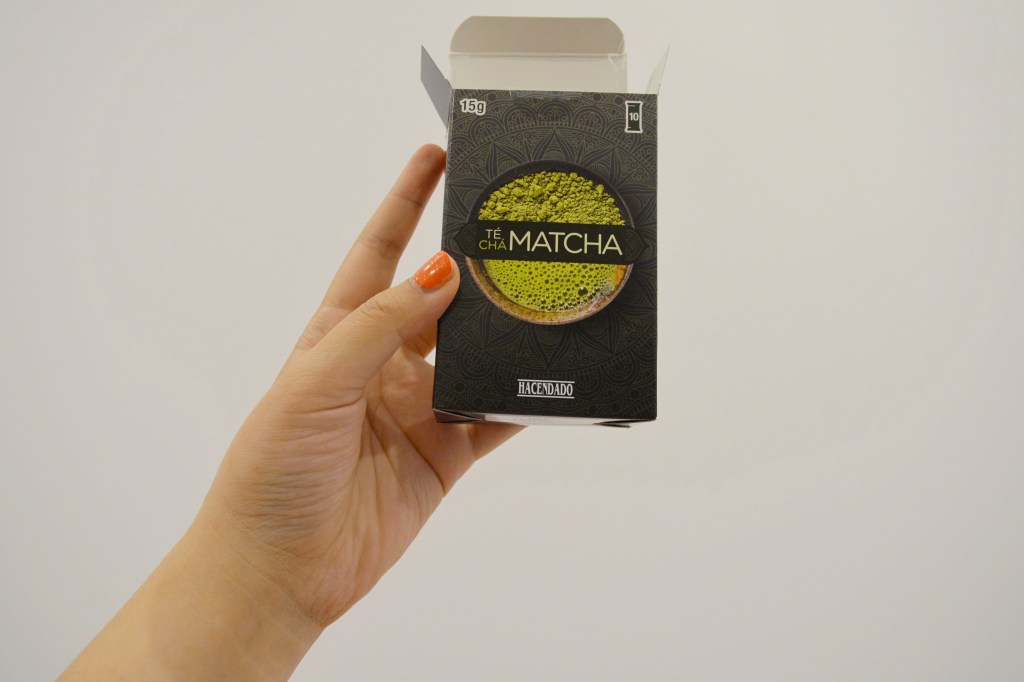
Speaking of desperation, most of Europe just did a quite arbitrary and extremely time-wasting one- or two-week pause of the AstraZeneca rollout, so who knows if I’ll ever get a dose. In the meantime, with the help of some store brand matcha packets, I made a cake with enough caffeine in it to distract us from COVID permanently. The brand of butter that I used was Flora, which has 0.2 grams of salt for every 100 grams of product, essentially “unsalted.”

Not-Well-Read Matcha Cake
Ingredients
- 4 packets (6 grams) matcha
- splash of water
- 3/4 cups oat milk
- 2/3 cups sugar
- 1/4 cups oil
- 1 1/2 cups flour
- 1/2 tsp baking powder
- 1/2 tsp baking soda
- 500g vegan butter, room temperature
- 2 cups powdered sugar
- meltable chocolate
Directions
- Preheat oven to 180 C.
- In a small cup, microwave a splash of water until steaming. Add in 3 packets (4.5 grams) matcha, and stir vigorously.
- In a mixing bowl, combine milk, sugar, oil, and matcha.
- Add in flour, baking powder, and baking soda, and mix until combined.
- Line a cake tin with parchment paper, pour in batter, and bake for 45 minutes.
- In the meantime, whisk vegan butter until soft.
- Add in 1 packet (1.5 grams) of matcha and powdered sugar until desired sweetness is reached. Refrigerate until ready to ice.
- Melt a tiny bit of chocolate and pipe whatever you’d like onto a piece of parchment paper. Place in freezer until ready to decorate.
- When cake is cooled, shave off top and sides to expose the beautiful olive color within.
- Top with buttercream and piped chocolate. Enjoy!
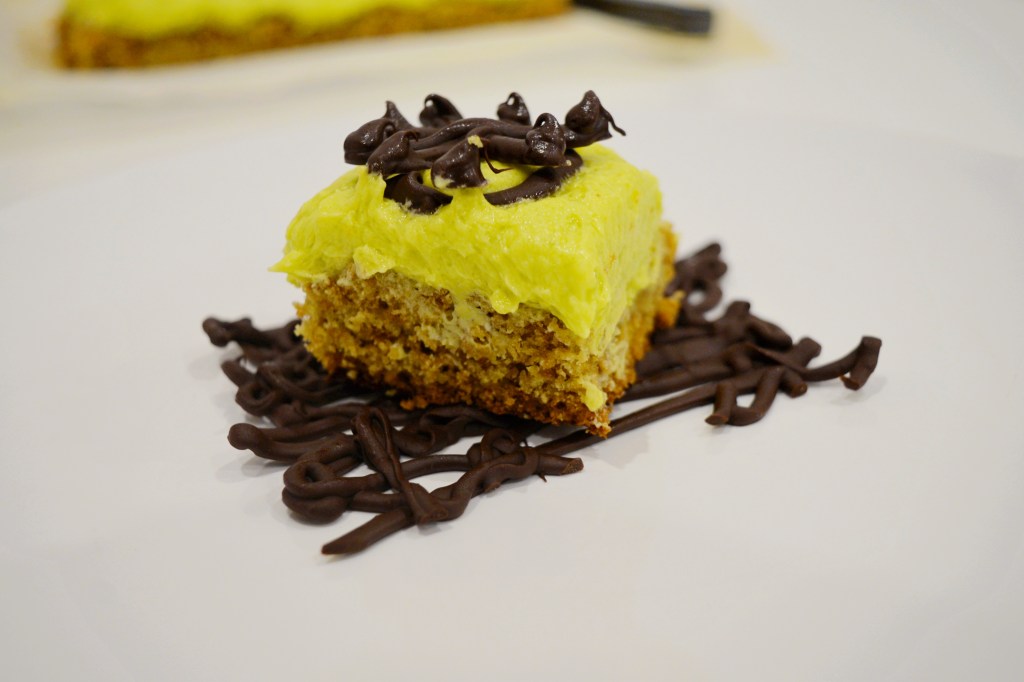
Makes 8 tiny slices, plus lots of scraps for cake pops!
 Racións
You must be logged in to post a comment.