The first time I was made hyperaware of my own race was a few years ago, in Buenos Aires. Strangers inquired too closely into where I was from and then proceeded to ignore my answers. My host family presented me with a casual anecdote about Asian people all looking the same. I was told repeatedly that I didn’t look like an American, who should be white at least and maybe even blonde-haired and blue-eyed. It was my first extended stay abroad, and through subsequent travels I learned that most places outside the US adhered to an even lower level of racial acceptance than the “colorblindness” that defined the suburbs where I grew up.
Becoming accustomed to race’s superseding of my age or gender or appearance or language abilities made me wary not only of the people I ran into on the streets of Buenos Aires but also of all the people I had ever run into my entire life, who may have dismissed me just as easily without my realizing. I thought of the old man at an event for recent admits to my university, a man in a checkered orange blazer and a pin proclaiming that he was a veteran of the Vietnam War, who asked me where I was really from when I pointed out that I lived twenty minutes away from the hotel ballroom where we stood. I thought of being alone in my room at nine or ten years old, whispering “why do I have to be Asian,” because though I lacked the words to say so I somehow knew by then that whiteness was the unspoken and untouchable standard, and then feeling ashamed for it, because I had been taught that I should see myself with colorblindness and was unable to do so.
The nestedness of racial experience is described superbly in the opening section, “A Pele,” of O Avesso da Pele, a recent (2020) novel by Jeferson Tenório. It’s the attempt of a young narrator to introduce the life of his assassinated father and how, even before the father knew much about or meant to assert anything about blackness in Brazil, his life had already been defined by it. Rather than tell the story in chronological order, Tenório is constantly shifting temporalities as one moment triggers the memory of another and then another. I loved it all the more because of its portrayals of education and of the classroom.
The protagonist is introduced to us as “você.” We quickly learn that he is the narrator’s father and that he leaves behind a life beyond death. It is not until halfway through the third chapter that we learn his name. He is having a conversation with Juliana, the first white girl that he dated. He had been going to weekly brunches with her family, who would relentlessly single him out for his blackness and accuse him of over-sensitivity when he looked uncomfortable. Although at first he sat through these jokes without speaking out, a class that he was taking with a Professor Oliveira gradually gives him the vocabulary needed to discuss the history and persistence of systematic racism, and he begins to dislike these insensitive brunch jokes to the point that he tells Juliana that he no longer wants to attend. When she asks why, he “respondeu que não queria mais ouvir aquele bando de racistas te chamando de negão toda hora, e que você tinha um nome e talvez eles nem soubessem que seu nome era Henrique.” His finally uttering his own name so late in the exposition is shocking and symbolizes a newfound deliberateness to his own identity in the context of race.
Professor Oliveira’s classroom, although mixed in atmosphere, is a place of empowerment for Henrique. The narrator thus describes his father as an exemplary student: “Você continua com suas anotações, ninguém interrompe a exposição do professor, alguns porque estão quase dormindo e talvez não se importem com essa história de raça; mas outros, como você, porque estão realmente interessados.” It is a place of discovering that lived experience is not enough for self-analysis and that there is more continuity than change in the perceived hierarchy of races since the beginning of colonialism. The reality of race’s invention changes Henrique’s perception of himself, and the subsequent breakup between Henrique and Juliana seems like a forgone conclusion: as would be expected from a white girl who has no reason to challenge the status quo of racial relations, “ela começou a ficar incomodada com toda aquela história de raça, preconceito e negritude. Por vezes, ela chegou a pensar que o professor Oliveira não passava de um fanático e que você estava indo para o mesmo caminho.” Just as learning about the idea of the “model minority” my freshman year of college helped me better understand myself, Henrique has undergone a transformation: “Será com ele que você tomará consciência de si e do mundo branco em que está inserido. Oliveira era poeta e professor de literatura. Usava cabelo black power. Barba grande. Você ficou impresionado com aquele profesor negro que falava de Shakespeare e Ogum com a mesma intensidade e beleza. A partir dali, sua vida não seria mais a mesma.”
We learn from the very beginning that Henrique is a schoolteacher in Porto Alegre, a city in the south of Brazil, which is predominantly white. The narrator sets the scene of him rather disinterestedly teaching a class of extremely disinterested students, and during an exam a student vomits on him and sends him into an existential reflection in the teacher’s bathroom. Minus the vomit, this description is hilariously accurate to my experience: “Você não está bem. Após alguns períodos e um vômito na camisa, você só quer ir para casa, tomar um banho e descansar. Mas você não pode fazer isso, porque tem mais dez períodos de cinquenta minutos pela frente. Você transformou numa máquina de dar aulas. Numa máquina de dar explicações. Numa máquina de ei, já pedi silêncio. Numa máquina de ei, preste atenção. Uma máquina de não pode ir ao banheiro agora. Numa máquina de paciência para não espancar aqueles alunos que não querem saber nada de orações subordinadas. Você também não quer saber de orações subordinadas. Mas escola foi feta para isso. Foi feita para aborrecer os alunos. E você sabe que é parte dessa chateação. A cada turma que você entra, a cada hora gasta da sua vida, você vai sentindo que está no lugar errado.” Are any students in these grammar classes taking a personal interest in the subject, as Henrique did in Oliveira’s class? Will they remember any of this material beyond their exams? It’s hard to make such an argument. Perhaps a real educational impact would be difficult to achieve without a confluence of an interesting curriculum and a system not designed to de-motivate students to begin with. The smell of vomit brings Henrique back to the memory of a military recruiter yelling and his perpetual sickliness, and the sense of defeat in the classroom brings him back to the very beginning of his career journey, with a racist boss who purposefully provokes him.
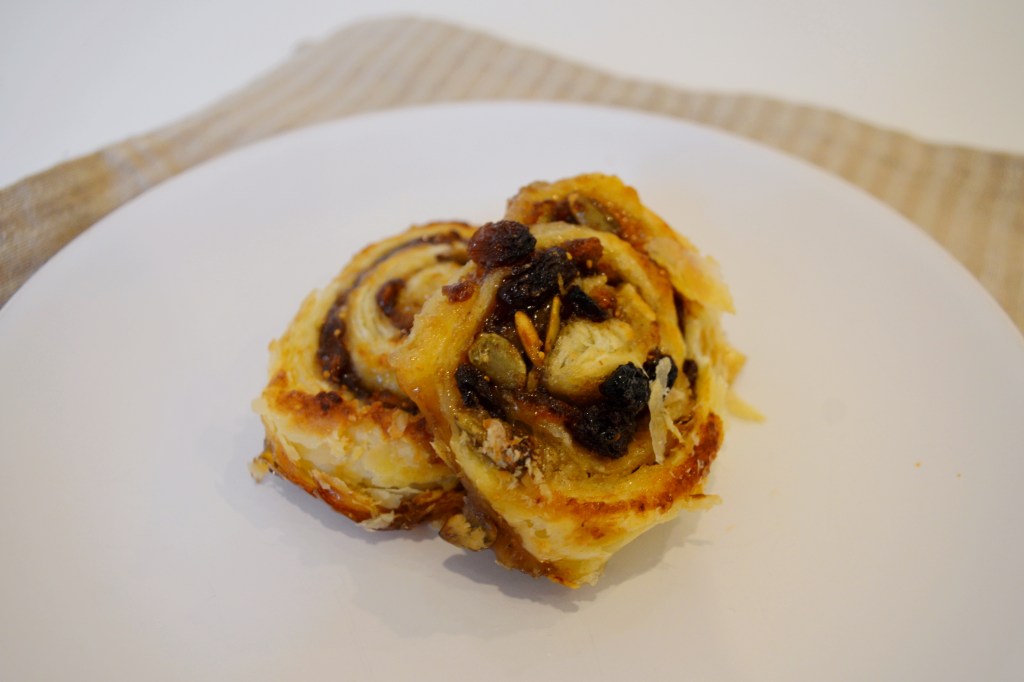
As with the nature of Henrique’s race-based trauma, always looking in on itself, creating webs of unrelated memories that flood his mind and only together can begin to describe what it means to survive in a world that rejects him, this week I’ve baked something quite multi-layered with the help of some store-bought puff pastry (masa de hojaldre). Inspired by the idea of a cinnamon roll, I piled on filling ingredients to a cold but pliable puff pastry sheet, rolled it up, and sliced it. It’s so simple it hardly qualifies as a recipe.

Messy Fig Nests
Ingredients
- 1 sheet puff pastry (defrosted)
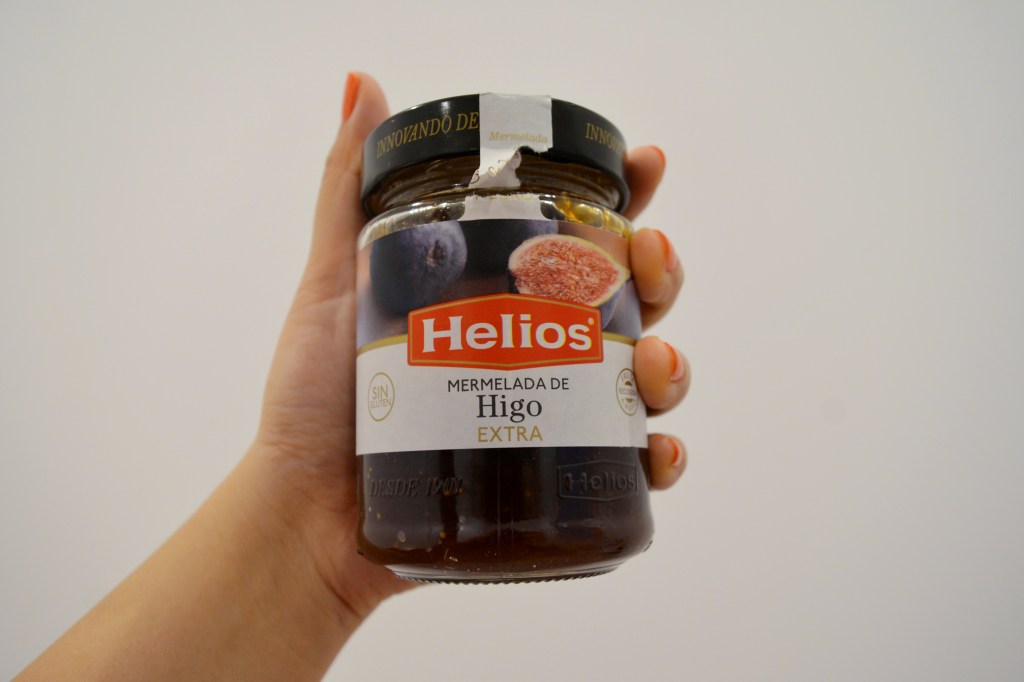
- half jar of fig jam
- 1/4 cup pumpkin seeds
- 2 tablespoons raisins
- 4 tablespoons vegan butter
- 1/4 cup sugar
- 1 teaspoon powdered ginger
Directions
- Preheat oven to 200 C and line a sheet with parchment paper.
- Thoroughly whisk sugar and powdered ginger in a bowl.
- Put butter in the microwave until just melted (20 to 30 seconds).
- Carefully unroll puff pastry on a smooth surface.
- Brush on melted butter; it should solidify a little upon contact with the refrigerated puff pastry.
- Spoon on fig jam and spread evenly.
- Sprinkle raisins, pumpkin seeds, and sugar mixture evenly over the puff pastry. Add other toppings if you’d like.
- Cut into one-inch chunks and lay horizontally on the lined sheet.
- Bake for 25 minutes or until slightly browned.
Makes 10 ‘nests.’
 Racións
You must be logged in to post a comment.