Our woefully still extant mid-October Columbus Day, which in recent years has been transforming into Indigenous Peoples’ Day, is celebrated in Spain as Día de la Raza, or “Day of the Spanish Race,” or in my school district, “Festa Nacional de España,” (“Spain Day”) both of which are alarming but at least correctly and honestly correlates nationalism and colonialism with Columbus’s legacy, as the date commemorates Columbus’s arrival in the Americas. The idea of the “Spanish race” and the European claim of colorblindness are so permeated into the national consciousness that, following a presentation on MLK and civil rights, when I asked my students to tell me about race in Spain, the teacher asked me to clarify, “do you mean racism? I don’t know what you mean by race—like the Spanish race?” A silver lining is that, unlike in the U.S., where October 12 was an opportunity for my elementary school teachers to make us memorize the “Niña, Pinta, and Santa Maria,” in my current school district it is at least a day off school, at last a positive piece to Columbus’s legacy.
Earlier this month, an article in American Antiquity revealed evidence that European goods reached the Americas before Columbus did. Specifically, it describes small turquoise glass beads, which the researchers date to between 1443 and 1488, found among similarly dated trade artifacts in northwestern Alaska. Their qualitative analysis, compared with a history of Venetian glassmaking, dates these beads to around or before 1486. As other known Venetian beads in the Americas date to much later and succeeded Columbus’s voyage in 1492, it is likely that the later beads arrived on ships, while these Alaskan beads travelled along the Bering Strait through Asia. The findings satisfyingly discredit the idea that Columbus was the first to facilitate trade between Europe and the Americas, even in the fifteenth century.
The settlements researched belong to the “Late Prehistoric Eskimo.” From a quick search in my university’s article database, “Prehistoric Eskimo” seems to be a pretty standard label. Nevertheless, Kunz and Mills feel it necessary to define it, saying that Vitus Bering’s contact with Alaskan natives in 1741 was the “event [that] ended Alaska’s prehistoric period” (1). Such a label seems to be in the same situation as the “Middle Ages,” a rather unloved period defined by its antecedent (Rome) and its descendant (the Renaissance), and one which has the annoying trait of requiring re-definition for every region (how many times have I had to explain that the Spanish Middle Ages end in 1492?). The contradictory combination of “late,” which implies an earlier history, and “prehistoric,” which implies that the period sits outside of history, may make it closer to the thankfully outdated label of “Dark Ages,” which purposely demeaned the period it described. In any case, it seems silly to say that native people in Alaska did not have a “history” at the same time that their Castilian brothers and sisters, for example, already had spent hundreds of years developing their cultural identity, simply because Western scribes and historians were not there to record it. And the existence of these beads and the metal jewelry already constitutes an albeit small history, unless we let old fashioned philologists define civilizations by their writing. I recognize that some labels necessarily have multiple meanings; a person in sixteenth-century Castile is “modern” to me but colloquially is very not modern. But labelling a people as pre-historic is akin to dehumanizing them. So perhaps the period referred to in this article would more aptly be called Relatively-Untouched-By-Europe or Completely-Untouched-By-Columbus.
Sometimes bias can be insidious, like Eurocentrism in academia. And sometimes bias can be sweet, like the bias of a mother for her child, or the bias of a woman’s imagination for her partner on a slow afternoon. This bias might properly be called, love.
This first poem is by American activist and writer Muriel Rukeyser (d. 1980). I took it from pages 415 and 416 of her Collected Poems, published by the U of Pittsburgh P in 2005. It was originally published in The Speed of Darkness in 1968.
Junk-Heap at Murano
for Joby West
You told me: they all went in and saw the glass,
The tourists, and I with them, a busload of them,
a boatload
Out from Venice. We saw the glass making.
Until I, longing for air—longing for something—walked
outside
And found my way along the building and around.
Suddenly there the dazzle, all the colors, fireworks and
jewels in a mound
Flashing from the heap of glass thrown away. Not quite
perfect. Perhaps a little flawed. Chipped, perhaps.
Here is one.
And handed me the blue.
I looked into your eyes
Who walked around Murano
And I saw far behind, the face of the child I carried outdoors
that night.
You were four. You looked up into the great tree netting
all of night
And saw fire-points in the tree, and asked, “Do birds eat
stars?”
Behind your eyes the seasons, the times,
assemble; dazzle; are here.
This second poem is by another activist and poet, Cristina Peri Rossi, from page 71 of her 1979 book Lingüística General. As I viewed an extracted online version of the poem, I have corrected two words that I believe were errors of transcription or text extraction—percepción from “perceptión,” and denominamos from “denommamos.”
1a Estación: Riva Degli Schiavoni
El antiguo prestigio de los viajes
desde épocas lejanas
permite suponer que el viajero
aumenta su percepción de lo sensible,
hasta descubrir—en la transparencia de un vidrio
rojo de Murano—
que ha doscientos años
sólo percibo la misma forma de ti
reproducida
como el árbol se refleja en el espejo,
arco de reflexión que denominamos coherencia
o índole obsesiva del amor.
Nada justifica sin embargo
el prestigio de los viajes
ni la delgada invención del amor
donde como en un vaso transparente
nos proyectamos.
Just as the little beads found in Alaska paint a whole new picture for our understanding of international trade in the late Middle Ages, the Murano glass in these poems allow the narrators to explore a part of themselves that they hadn’t yet realized. The first is actually about Murano, the Venetian islands where the fine glass is made. If my trip to Venice had been longer than a day, I might have visited. The simplicity of the metaphor is refreshing: the glass shards for discarded memories, the colors for the wonder in a child’s eyes. The second is about Riva Degli Schiavoni, the waterfront area in Venice where nowadays you start gondola tours of the city. Rossi specifically refers to a red Murano vase (perhaps red for passion?) but it would not be unusual to see Murano glass of all colors from this waterfront, as jewelry and trinket stores abound in the area. She begins with the familiar idea that even exploring very extensively could not change the inevitable conclusion of love; then, she elevates their love to the proportion of epic journeys, defined not by heroic accomplishments but by her ability to feel their love coursing through something as small as a vase in a waterfront shop. Although the glass is transparent, it acts as a mirror for their bond, presented as something historied and long lasting, like Murano’s glass industry itself.
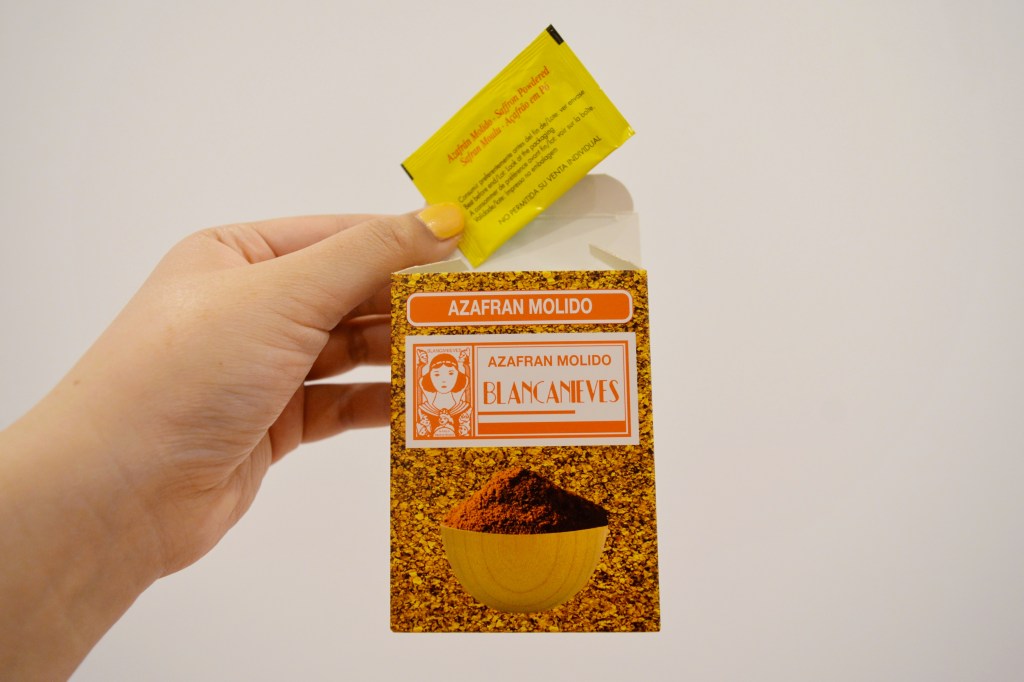
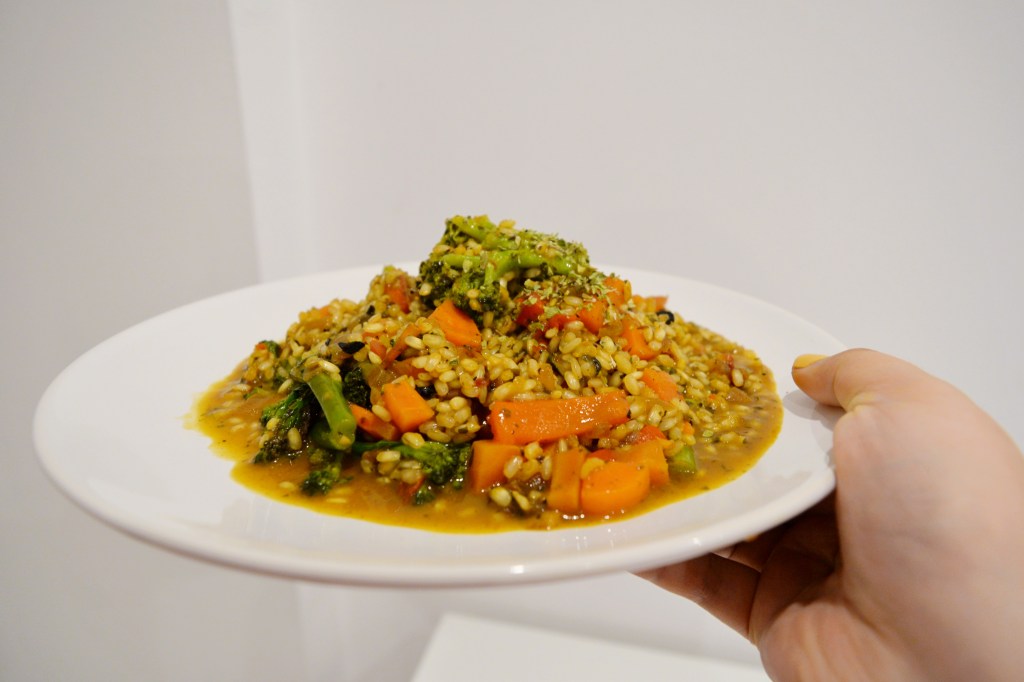
Last week I went to a cute bulk store that sold brown arborio rice with different mixes of dehydrated vegetables already incorporated. These vegetables, along with the fresh vegetables that I added, offer a beautiful array of colors, perhaps akin to the splashes of color in a Murano vase or sculpture. These colors might have included yellow too, but the saffron packets that I added were unfortunately so under-filled that its color was overpowered by the broth.

Junk Glass Risotto
Ingredients:
- enough bouillon cubes for 8 cups broth
- olive oil
- 1 head broccoli
- 1 bunch broccolini
- 1 red bell pepper
- 1 carrot
- 6 cloves garlic
- 1 onion
- 2 1/2 cups brown arborio rice
- 1 cup white wine
- vegan cheese, chopped into tiny pieces
- saffron
- salt, pepper, oregano to taste
Directions:
- Dissolve bouillon cubes in boiling water. Put pot with broth aside.
- Dice carrot and bell pepper. Separate broccoli into florets. Mince garlic.
- Put garlic and oil into a pan on medium high. After a minute, add the rest of the vegetables.
- Dice onion, and add it to a large pot with oil on high heat. Add seasonings now; you probably won’t need much salt because bouillon tends to be pretty salty already.
- When onion is softened, add in arborio rice. From this moment on, until the end of the recipe, stir continuously.
- When rice is slightly browned, add in wine. It should steam up immediately and evaporate quickly.
- Add broth one ladle at a time, waiting until broth is almost evaporated each time. For white arborio rice this normally takes 20 minutes, but with brown arborio rice it took me about an hour. If the broth runs out and the rice is still crunchy, keep going with water. If you want more wine flavor, add a ladle more of wine. The heat should be as high as you can turn it without rice burning on the bottom.
- With your final ladle of liquid, add in vegan cheese and saffron.
- Turn heat to low, and incorporate the vegetables from your pan.
- After a minute, turn heat off and enjoy!
Makes 4 meals.
 Racións
You must be logged in to post a comment.