I love sitting by the ocean. There’s the immediacy of sand, the shifting ground underneath you, the uncovering and burial of little opal shell fragments, the dogs running past. Then there’s the waves that come from somewhere beyond the horizon, continuous without losing its intrigue, its promise, satisfyingly out of reach. It’s a type of optimism that doesn’t require optimism’s charm or energy or production.
This week I looked at two poems from the early twentieth century. The first is by Rafael Alberti, from pre-Spanish-Civil-War Spain, in a book called Marinero en tierra (1924), which is apparently commonly included in school curriculums in Spain.
Sueño del marinero
Yo, marinero, en la ribera mía,
posada sobre un cano y dulce río
que da su brazo a un mar de Andalucía,
sueño en ser almirante de navío,
para partir el lomo de los mares
al sol ardiente y a la luna fría.
¡Oh los yelos del sur! ¡Oh las polares
islas del norte! ¡Blanca primavera,
desnuda y yerta sobre los glaciares,
cuerpo de roca y alma de vidriera!
¡Oh estío tropical, rojo, abrasado,
bajo el plumero azul de la palmera!
Mi sueño, por el mar condecorado,
va sobre su bajel, firme, seguro,
de una verde sirena enamorado,
concha del agua allá en su seno oscuro.
¡Arrójame a las ondas, marinero:
-Sirenita del mar, yo te conjuro!
Sal de tu gruta, que adorarte quiero,
sal de tu gruta, virgen sembradora,
a sembrarme en el pecho tu lucero.
Ya está flotando el cuerpo de la aurora
en la bandeja azul de océano
y la cara del cielo se colora
de carmín. Deja el vidrio de tu mano
disuelto en la alba urna de mi frente,
alga de nácar, cantadora en vano
bajo el vergel añil de la corriente.
¡Gélidos desposorios submarinos
con el ángel barquero del relente
y la luna del agua por padrinos!
El mar, la tierra, el aire, mi sirena,
surcaré atado a los cabellos finos
y verdes de tu álgida melena.
Mis gallardetes blancos enarbola,
¡oh marinero!, ante la aurora llena
¡y ruede por el mar tu caracola!
The second is by Fernando Pessoa, from the book Poemas de Alberto Caeiro, first published in 1946 and re-released again and again since. In 2007, Shearsman published the volume in English, but it’s unfortunately not available through my university library. From the brief snippet that I found floating on the internet, though, it is interesting that Daniels, the translator of this volume, translates “guardador de rebanhos” as “keeper of flocks,” which is much more word-by-word faithful and specific to this particular book of poems, while Roditi, in 1955, called it “herdsman,” which is more understated and perhaps more conjuring of the biblical image of a shepherd. Elsewhere on the internet I see it translated as “keeper of sheep.” This is such a fascinating phrase because “herd” is broader and, though it could refer to sheep, refers more easily to cows, and for the purpose of non-domesticated animals it also fits well with zebras or rhinoceroses or other heavy, hooved animals. On the other hand, “flock” refers more pointedly to sheep and could never be used with cows, though for non-domesticated animals it also fits with goats and geese and other birds that are light and well suited to flying (which sadly excludes penguins). The NIV frequently uses them both side by side as “flocks and herds,” thereby distinguishing one from the other. “Herd” is also more frequently used to refer to animals, whereas “flock” is used more frequently to refer to human beings, in the metaphor of Jesus as shepherd. It is plain that, in meaning, Pessoa is referring to a shepherd, a person who tends sheep. However, if he intended it to be read as “shepherd,” he would have used the word “pastor.” The next closest thing would be “herdsman” or “herder,” but these have the implication of quite a weightier, more aggressive animal than sheep. To move into multiple-word translations, “guardar” encompasses so many definitions (to keep, to preserve, to watch, for example), and “rebanho,” conveniently absorbing the definitions of both “flock” and “herd,” has no satisfying equivalent in English. Since in the poem “Sou um Guardador de Rebanhos” Pessoa writes “O rebanho é os meus pensamentos,” the relationship between man and sheep must be something closer to overseeing than to guardianship or “keeping,” which only reminds me of archaic English (see KJV Genesis 4:9, “Am I my brother’s keeper?”), but “overseer” in modern English is tied to slavery and thus has entirely the wrong connotation. As for my personal preference, I think “herder,” or even something species-neutral like “tender,” can apply quite nicely to both thoughts and sheep and points more toward the action (herding/tending) than the recipient (keeper of flocks) and does so without sounding too overtly like a profession (herdsman). It also rids us of the awkwardness in the first line of the Roditi translation, “I’m herdsman of a flock,” which, aside from the flow being disrupted by the lack of an article, sounds discordant, since herdsman would go better with herd, and shepherd with flock, but this would in turn render the whole line redundant; I suspect this is why Roditi opted for a much more concise “The Herdsman” as the title, instead of calling the unnamed poem by its first line, as it is typically in Portuguese. All that to say, I would probably go with “tender of flocks.”
X
«Olá, guardador de rebanhos,
Aí à beira da estrada,
Que te diz o vento que passa?»
«Que é vento, e que passa,
E que já passou antes,
E que passará depois.
E a ti o que te diz?»
«Muita coisa mais do que isso,
Fala-me de muitas outras coisas.
De memórias e de saudades
E de coisas que nunca foram.»
«Nunca ouviste passar o vento.
O vento só fala do vento.
O que lhe ouviste foi mentira,
E a mentira está em ti.»
Although these authors and poems are in no way directly related, they respond to each other delightfully well on the subject of now versus future, the real versus the imaginary, the sand versus the horizon, the post-Covid dreams versus the locked down now. In the Alberti, the sailor is describing not a specific vision but an entire rainbow of possibilities, from the north to the south, from the freezing ice to the tropical sun. The natural features of the sea are personified as a blushing young woman so that the narrator is transformed from bachelor to husband, from human to transcending humanity. In the Pessoa, on the other hand, the narrator tells his companion that “memory and longing/And what never was” is all a foolish lie and that “the wind only speaks of itself.” Trusting one’s imagination will only lead to a distortion of reality; it’s best to be content with what we objectively sense to be true.
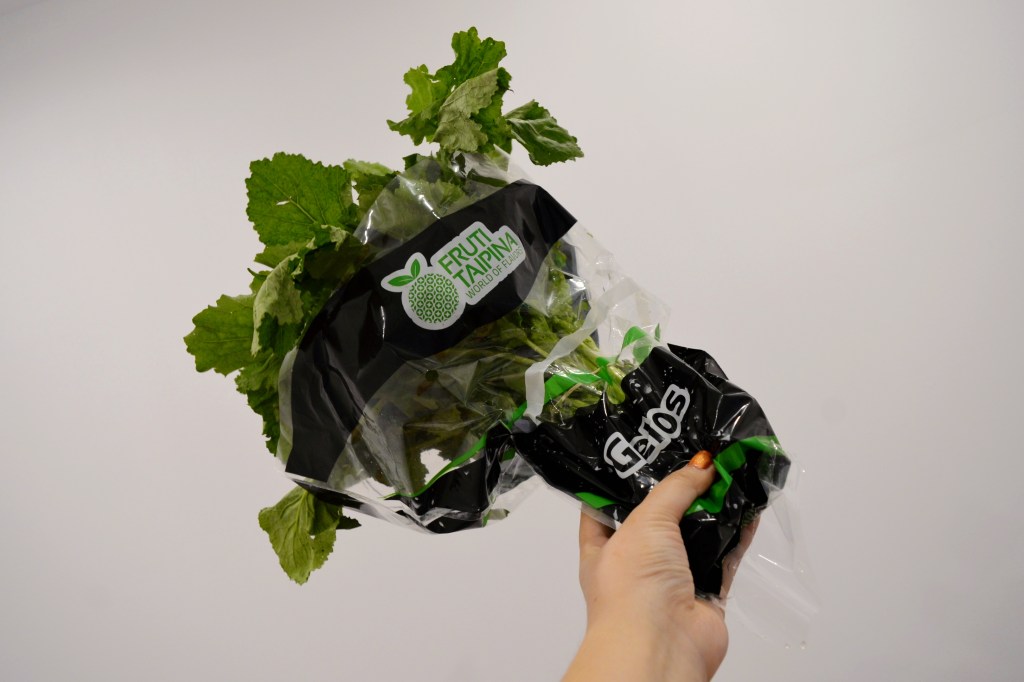
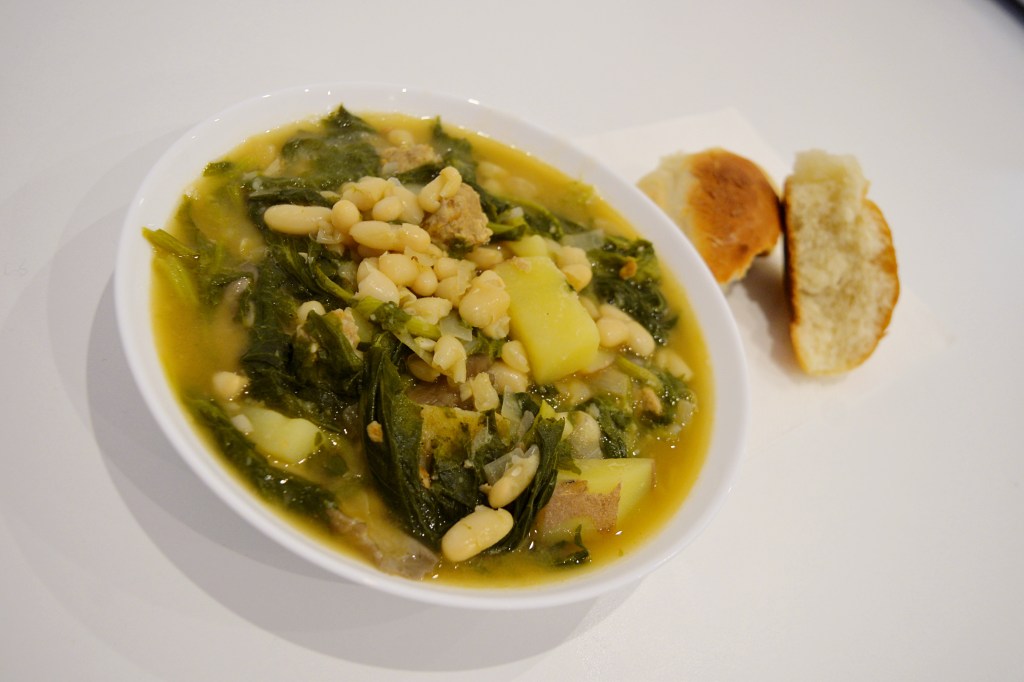
Recently my students introduced me to a local vegetable called “grelos.” English Wikipedia calls it “rapini” or “broccoli rabe,” while my dictionaries call it “turnip tops” or “turnip greens.” I don’t think either are quite right, since “broccoli rabe” to me is a synonym for broccolini, and the pictures of “turnip greens” that I saw on google are a totally different leaf shape. I looked up a grelos stew recipe but had to majorly adapt it given that it used four different types of animal flesh; the final product was thus both a reference to tradition and a distortion of it.
Windy Grelos Stew
Ingredients:
- 1/4 kilo dried white beans (soaked for 8 hours)
- 12 cups vegetable stock
- 1 package fake meat (diced)
- 1 package oyster mushrooms (lightly shredded)
- 1 onion (diced)
- 2 cloves garlic (minced)
- 2 potatoes (diced)
- 2 bunches grelos (stems removed)
- salt, pepper, paprika
- sesame oil
Directions:
- Mix up vegetable stock in a huge pot. Add drained beans and cook for 1 hour, as high as your stove will go without boiling over. Season with salt, pepper, and paprika.
- In a separate pot, sauté fake meat, oyster mushrooms, onion, and garlic until mushrooms are softened.
- Add potatoes into large pot with the stock and beans.
- Ten minutes after adding potatoes, add the grelos, one handful at a time so that they have room to shrink down.
- Ten minutes after adding grelos, add in contents of the other pot, with a drizzle of sesame oil.
- Simmer two minutes more, then serve with bread. I made these dinner rolls with 1.5x the sugar.
Makes 8 meals.
 Racións
You must be logged in to post a comment.