Given the enormous disappointment this week regarding the probable lateness (mid-March?) and pitiful amount (1400, rather than promised 2000 dollars) of the proposed stimulus checks in Biden’s administration, this week I looked at a piece by Thomas Tenison, late 17th-century Archbishop of Canterbury, called “A Sermon Concerning Discretion in Giving Alms. Preached at St. Sepulchres Church in London, instead of the Spital, upon Wednesday in Easter-Week, April 6, 1681” (2nd. edition printed 1688, scanned into microfilm in 1980 and digitized in 2019).
About a century after the Protestant Reformation had begun, the sermon still focuses on the virtues of the Church of England, which distributes alms with “discretion,” over Roman Catholicism, which through its alms encourage “vice” and nourish “Plagues” and “Diseases.” In a similar vein to political figures today who decry public welfare as encouraging of dependence and moral indolence, Tenison associates judiciousness in the distribution of alms with Protestant wisdom. Fittingly in the context of the “thoughts and prayers” platitude that has now been endlessly mocked, he notes that the only way to help all who need it is through “charitable Prayers” (32).
He suggests that indiscriminately given charity is sinful: “we shall make it necessary for us to repeat this Prayer (for which there is too frequent cause; though, I fear, it is very rarely used) ‘God forgive me the prodigality of my Alms, God forgive me the indiscretion of my Charity’” (14). Over-generosity is a sign of personal failure: “It is storied of Mr. Fox, the Author of the English Martyrology, that he could deny no man who asked of him an Alms in the name of Jesus. His Piety is to be highly valued; but, surely, the weakness of it is not to be drawn into imitation” (49). And just as there is a common suspicion that panhandling or houseless people are lazy or dishonest, Tenison warns that “there are many who are reconciled to very ill circumstances, as pretences to beg with. They would not part with their Ulcers, their Scars, their Crutches, lest they part with their idleness and their Alms” (52).
Like conservative Americans today who advocate for private philanthropy rather than tax-funded benefits, Tenison writes that “it is our wisdom to raise and maintain […] a private bank of Charity, by laying aside a convenient share of our worldly Incomes for so worthy a purpose. It will grow insensibly: […] And this being done, we shall then not be to seek for Alms upon sudden and emergent occasions” (17). I believe that “alms,” which were distributed by the two then barely separable institutions of church and state, would have been considered the more lofty and institutional alternative to this “private bank.” On the other hand, although his proposal sounds suspiciously like an income tax, the “convenience” of the share suggests that it is entirely voluntary, and the fact that he said it might “grow insensibly” shows that he places an absurd amount of trust in the goodheartedness of the wealthy.
His annoyance is specifically directed toward cloistered Catholics who “by feeding the the slothful, the superstitious, the Enthusiastick, the Fryars Mendicants, the Pilgrims or loytering wanderers of that Church, provided Objects of Burthen and expence, for those of the Reformation” (23). As at this time monasteries had been disbanded for over a century, anti-Catholic sentiments were common, and the Pope no longer had control over his archbishopric, perhaps Tenison is referring to the memory of Catholic monastic institutions from the fifteenth century. This reading would be especially ironic because, although monasteries always outwardly claimed alms-giving as one of their greatest objectives, and although some monks and nuns did renounce wealth and other worldly comforts, in reality monasteries throughout the Middle Ages served to consolidate, preserve, or divert the wealth of noble families; they certainly were not giving handouts with reckless abandon.
On a final note, since I am currently teaching classes to future sailors who will soon leave the classroom to begin apprenticeships, I found it quite exciting that Tenison includes vocational training as an example of the good use of public funds. In this instance he fortunately approves of the use of these “alms” because he is politically in agreement with his king, Charles II. At Christ’s Hospital, a boarding school, “many have proved eminent in divers Faculties, and in Offices Sacred and Civil, and arriv’d at great things from very low beginnings. Ten of the foremention’d Children have been, this year, placed out to Masters of Ships, having first been educated in the arts of Arithmetick and Navigation by the Royal bounty of his most Excellent Majesty, whose great and wise example ought highly to be honoured” (28).
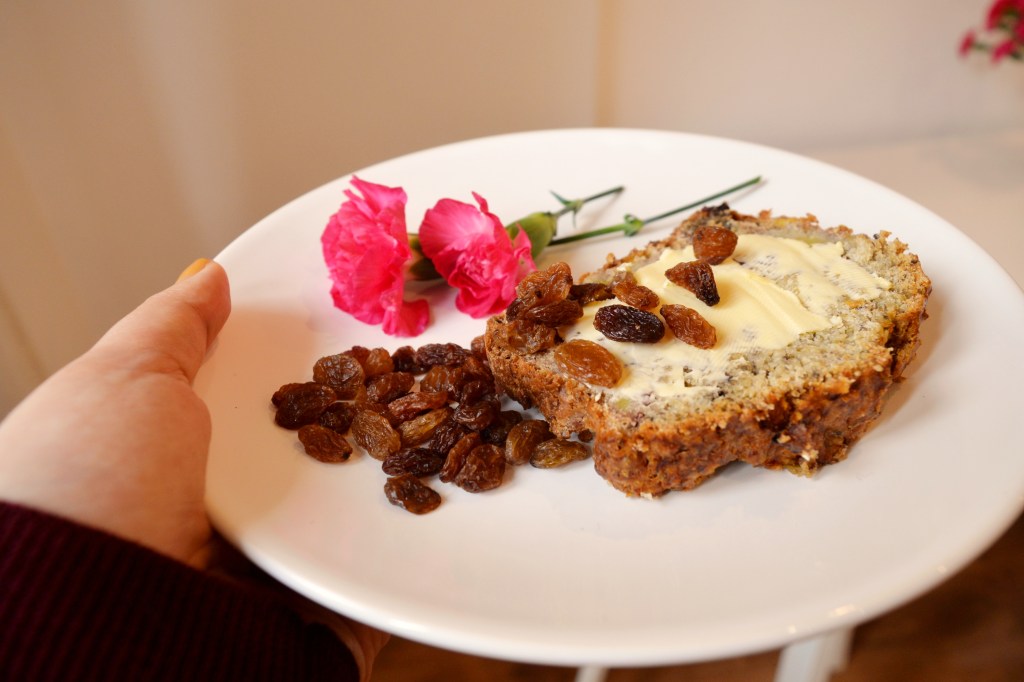
Although the Protestant work ethic that Tenison implicitly endorses still thrives today, the simple quickbread that I’ve made this week would have been unthinkable for him, as baking soda and baking powder were not available until the nineteenth century, although Tenison may have had access to some cane sugar, since by his time slavery-dependent sugar plantations in the Americas were booming. He probably would not have had multiple sweet bananas at his disposal, as banana trade does not seem to pick up until the late nineteenth century. Thus, if he were presented with a bunch of bananas, I imagine it would be a moment of immediate and enthusiastic curiosity. The common story that bloggers tell of unwanted bananas sitting on the counter rendered nonsensical in this context, I present an adapted recipe using unripe, straight-from-the-grocery-store bananas.
Untouched-By-Apathy Banana Chunk Bread
Ingredients:
- 4 unripe (un-mashable) bananas
- 2 tablespoons chia seeds
- 1 cup unsweetened rice milk
- 5 tablespoons melted coconut oil
- 1/3 cup sugar
- 1/2 cup quick oats
- 1 teaspoon baking soda
- 1 teaspoon baking powder
- 1 1/2 cups flour
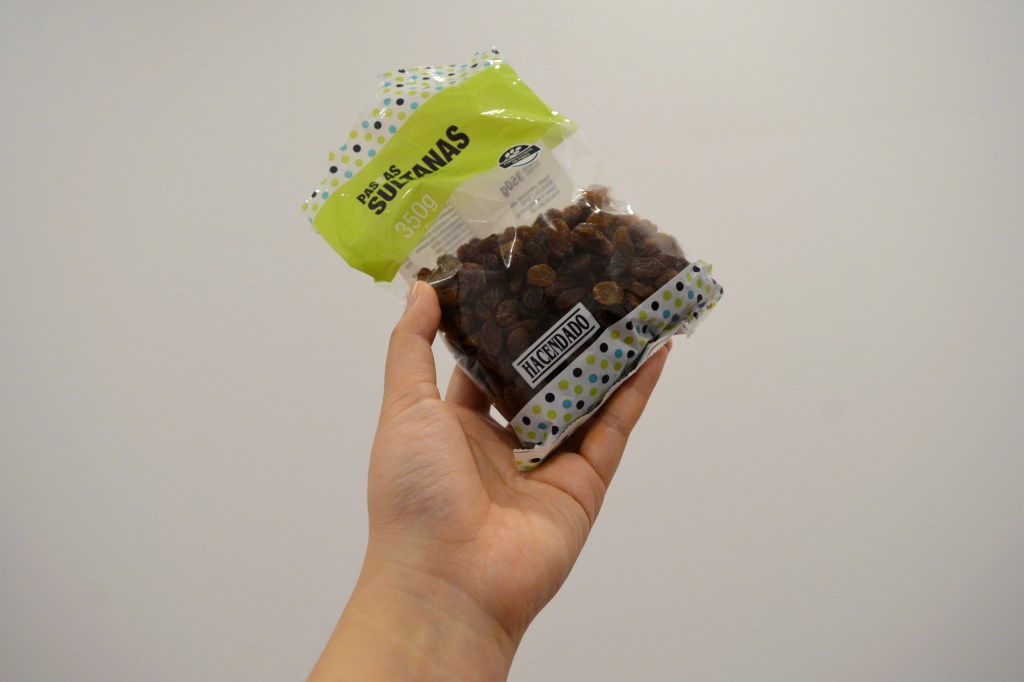
- 1/3 cup golden raisins
Directions:
- Preheat to 180 C. Line a loaf pan with parchment paper.
- Roughly chop the bananas into bite-sized pieces.
- With a fork, mix in the rest of the ingredients, working quickly so that the coconut oil doesn’t re-solidify.
- Pour into loaf pan, and bake for 50 minutes.
- Cool slightly, then enjoy! Stores covered in the fridge for a week.
Makes 1 loaf.
 Racións
You must be logged in to post a comment.